June 5, 2007 at 10:49 pm · Filed under Places to go
It seemed we were doomed again in our attempt to boat on Lake Mead. Last night the wind began to pick up, and by morning it was whipping a blast of hot air at us. This meant white-capped waves across the broad section of the lake, and a bumpy ride — just like last year.
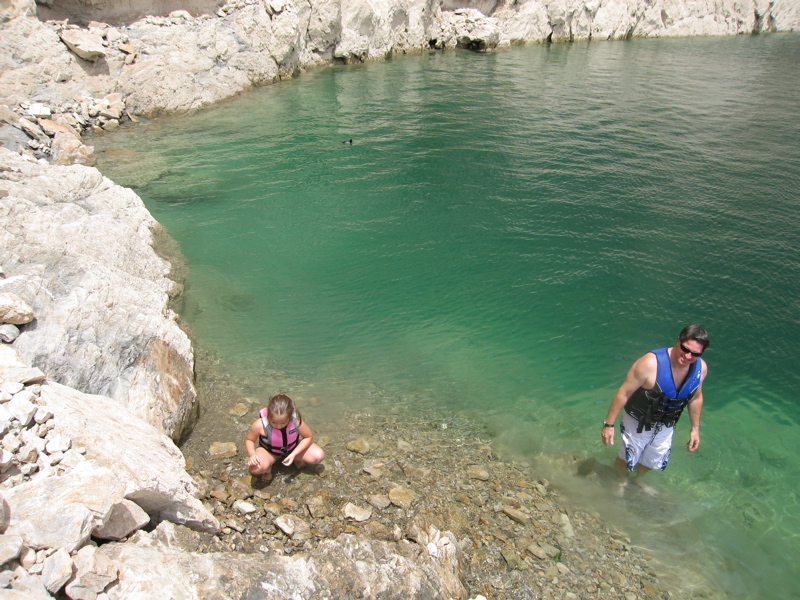
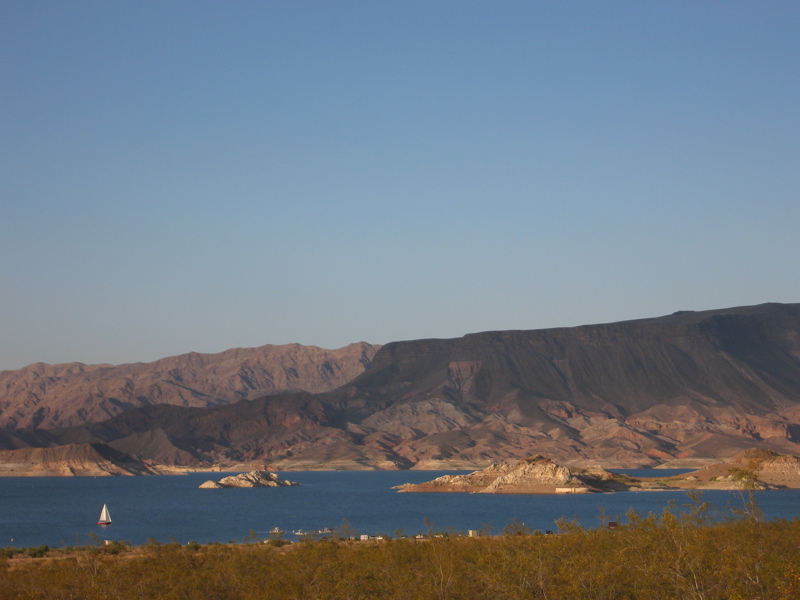
But Lake Mead has an abundance of sheltered little coves, formed by the crannies and canyons of what was once wind-sculpted desert. We made for those as quickly as possible, and found tranquil blue-green water surrounded by dark brown canyon walls, perfect for diving and swimming.
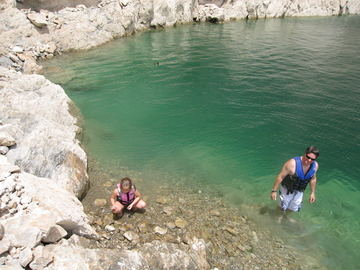
Who thought of putting a lake in a desert? It’s a marvelous invention. There’s nothing like jumping into cool blue water with a 110 degree dry breeze above. (But remember to apply the sunscreen early and often. We used SPF50 water-resistant sunscreen and still got a little red in spots.)
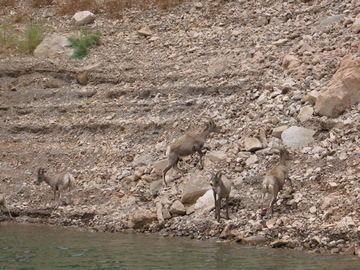
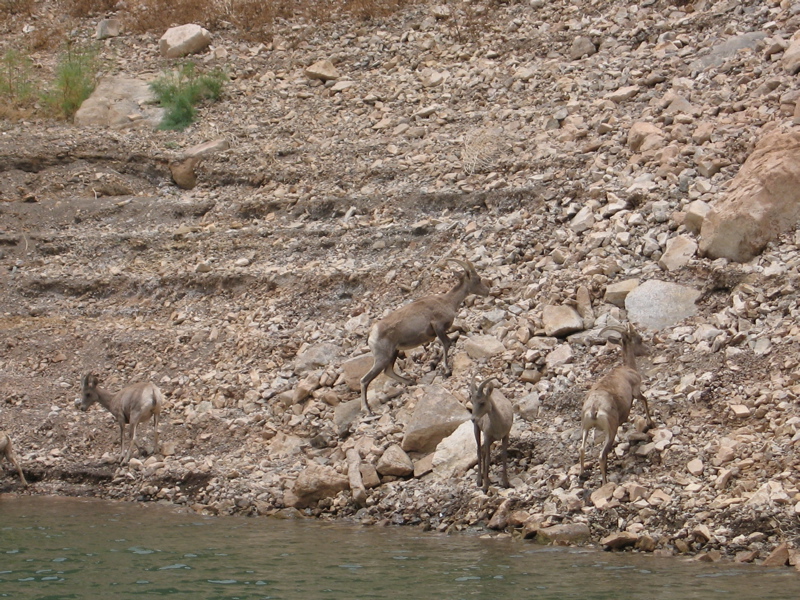
As we jumped from cove to cove, we spotted some wildlife. The best surprise was a small herd of about 18 pronghorns who had come down to the lake edge to drink. We were looking at them, thinking how strange it was to encounter these mountain animals alongside a lake, and likewise they were wondering what a boat was doing in their canyon. At another cove, we spotted herons nesting, and a duck that we could not identify, with unusual plumage.
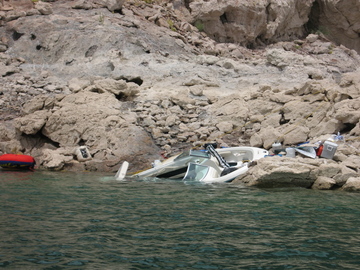
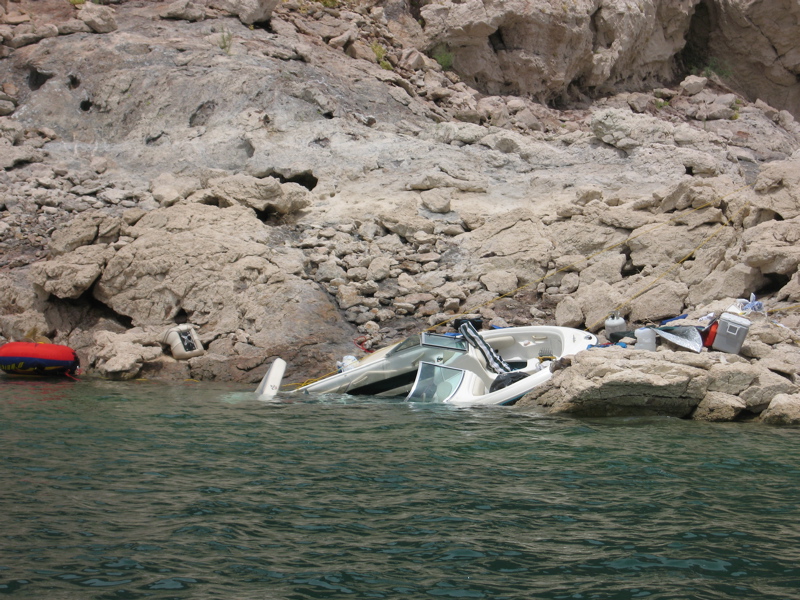
The most startling sight was this crashed boat. Only a couple of hours earlier we had seen a family pulling a tube behind this boat. When we arrived, they had apparently been rescued but the boat and all of their possessions were left behind. Although the boat was completed destroyed, it looked like the accident was survivable. A reminder of the need for boating safety …
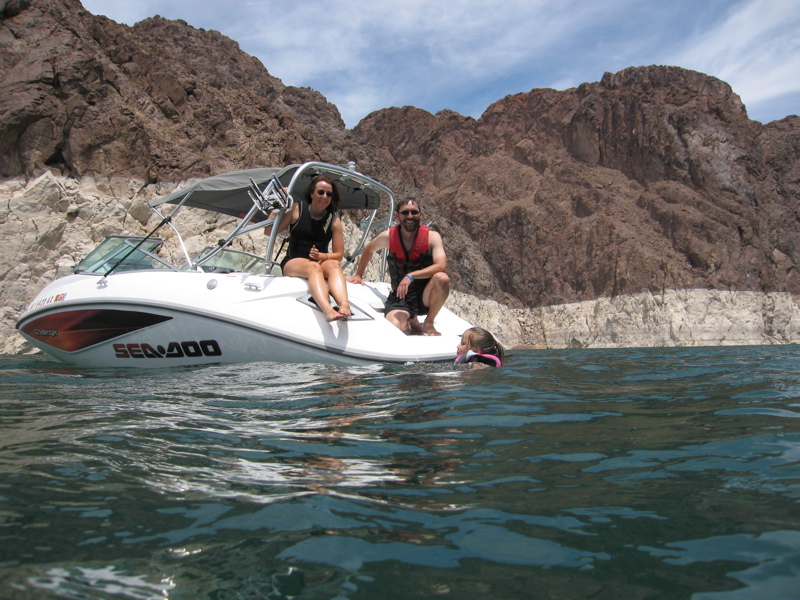
The last stop of the day was back at Hoover Dam. There’s a small cove just before the buoys that warn you not to get closer. In this cove there is an unofficial anchorage. I named it “Moocher’s Cove” because of the ducks and large friendly fish that swam up to us looking for handouts. It was the idea spot to hang out and swim and snack for the last hour of the afternoon: calm, quiet, sunny, with delicious cool water.
This evening we have another guest in the Airstream. My mother has flown in from Vermont. That makes five people in here for the next two nights. This is the largest crowd we have ever had sleep over, and yet it feels very natural.
Tonight Emma and my mother are settling in on the converted dinette bed, Brett is in the back bedroom, and Eleanor and I are in our front queen bedroom. Emma is reading a bedtime story to my mother from the book she is writing, I’m up front blogging, Brett is in the shower, and Eleanor is preparing for bed. Being here together on the shores of Lake Mead with a balmy wind gently rocking the trailer seems to have made us all very comfortable. I think this will be a day we look back on for years and say, “That was a great day.”
June 4, 2007 at 11:18 pm · Filed under Uncategorized
Yesterday Emma suggest we name the rental boat Titanic, but Brett pointed out that we would prefer a lucky name. It turned out to be an apt suggestion by Emma.
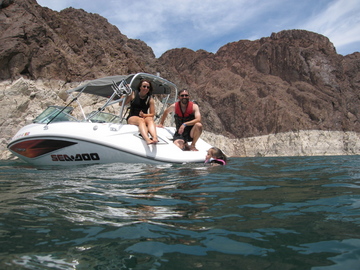
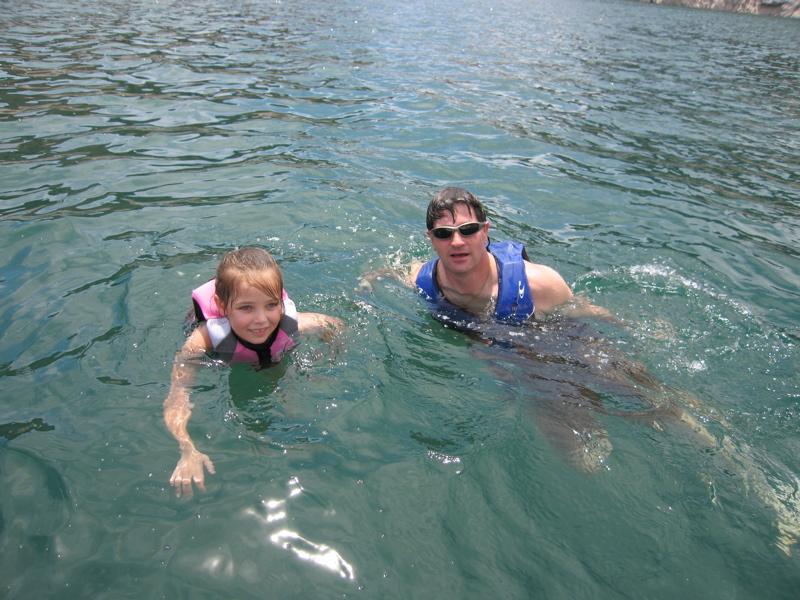
The day started off well. We got work under control and the boat ready by 11 a.m. and headed out to the Hoover Dam area. The water runs about 400 feet deep or more in Black Canyon, just up from the dam, and the water was a 80 degrees or so, which felt perfect when jumping off the boat in the 108 degree air.

Emma and Brett floating near Hoover Dam
A few miles northeast, we were exploring a cove when Brett noticed the boat wasn’t performing as well as it should. He checked in the bilge and found it full of water. We were “taking on water”, which is a polite way of saying we were sinking. Moreover, the bilge pump didn’t work.
Fortunately a boat like this won’t sink completely, but if we’d left it alone it would have eventually flooded the engine compartment and then it would have been a matter for the Coast Guard. We pulled the drain plugs, piled three of us in front to get the boat on plane (counteracting the weight of the water in the bilge), and zipped across Lake Mead back toward the marina.
We pulled the drain plugs so that when the boat was moving at speed, the water would drain out of the plugs. This worked, but once we were back at idle and docking we found water flowing back into the bilge very quickly.
Several calls to the boat rental company ensued. In the end, they came out to fix the boat, and when it couldn’t be fixed on the spot, they took it away and brought us another one. By then, it was 5:30, and Leigh & Brian were coming over again for dinner.
We’ll try again tomorrow. Unfortunately, the wind has picked up and it seems likely we’ll have a bumpy ride tomorrow — reminiscent of our attempt last year to ride jetskis on Lake Mead. It’s still a beautiful lake, but I wish we’d have more luck with the weather.
June 3, 2007 at 8:37 pm · Filed under Uncategorized
If you’ve followed this blog for over a year, or read the archives, you may recall our last experience with Lake Mead. Brett and I rented jetskis on a windy day and were basically flogged by the lake until we crawled out of it, bruised and missing a few things.
This year we vowed to try again. We have rented a 22-foot jet boat so that Eleanor and Emma can join us. Brett flew in this morning and we picked up the boat in the afternoon. We’ll take our first ride on the lake Monday morning.
Renting a boat is much harder than renting a car, renting a 28-foot box truck, or running for President of the United States. At least when running for President you don’t have to sign half a dozen liability releases and watch a tedious 30-minute safety video. (But maybe that’s not a bad idea — it might cut down on the crop of publicity-seeking candidates.) We endured the process and at the end I think we basically agreed to buy the boat if we ding it.
That may be a small challenge. Lake Mead is down to its lowest level in 40 years. There are islands poking up that we didn’t see last year, and some shallow areas are now dry. The low level is quite visible as a white “bathtub ring” on the rocks. The white is caused by minerals deposited on the rocks, not by bleaching as a lot of people guess.
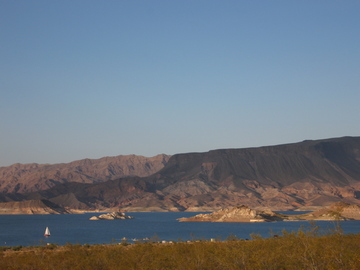
Fortunately, the canyons are very deep and still run 300-400 feet. That’s also where the nicest boating can be found, so we’ll concentrate some time there and try to avoid the various submerged objects (ferries, airplanes, even an entire town) that Lake Mead normally covers. With some luck, our day on the lake will be much more successful than last year.
June 2, 2007 at 11:29 pm · Filed under Uncategorized
We’ve relocated to Lake Mead National Recreation Area, near Las Vegas, Nevada. This is the man-made lake formed by the building of the Hoover Dam. It’s a big blue-green splash surrounded by the small jagged hills of Mojave Desert.
It’s hot. Really hot. Today we hit 110 degrees by 2:00 pm, and it stayed above 100 most of the day. The air conditioner in the Airstream can’t keep up. It runs continuously to keep the interior in the upper 80s. We’ve decided that after 105 it’s not so much fun, but it is certainly novel.
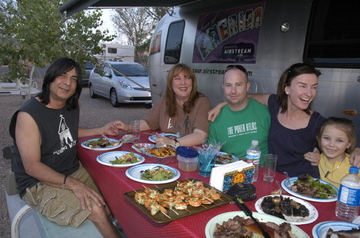
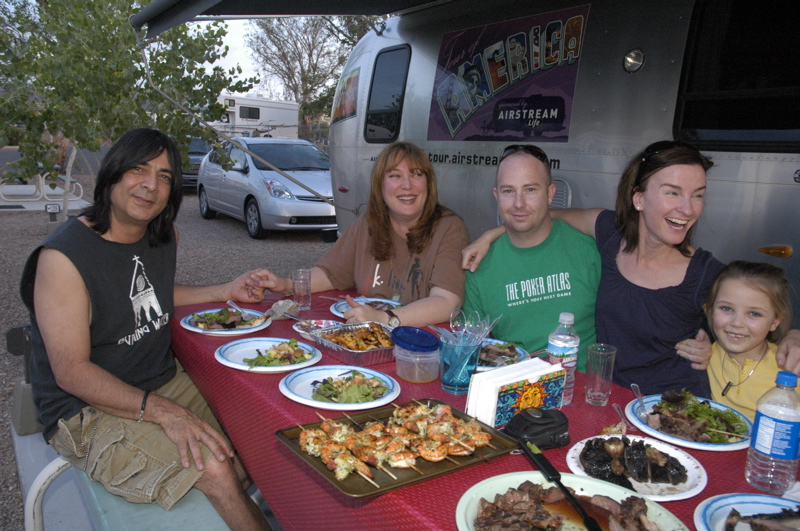
I’ve been anticipating tonight for weeks. We had some special friends coming over for a barbecue. In the picture above (left to right) are Phil and Anita, Brian and Leigh, and Emma. Anita was formerly the personal assistant to a certain movie star whose trailer we are re-doing inside the pages of Airstream Life magazine. We became friends over the phone during the past year, and this is the first time we’ve been able to meet face-to-face.

The same is true of Leigh and Brian. They recently came off the road after 650 days full-timing in their 1963 Airstream Flying Cloud. Their blog was a daily “must read” for me over the past year, and we’ve been communicating via email during that time. Now that they’ve settled in Las Vegas, we had to meet up.
So we got our friends together for a single great night, and cooked dinner on the grill over charcoal in the 100-degree heat. It was fabulous. Grilled shrimp, steak, chicken, mushrooms, onions, plus salad by Leigh and tons of neat appetizers & desserts courtesy of Anita. And great times with the friends we’ve never met before.
This reminds me that it’s not just the travel opportunities that make this full-timing life so appealing. It’s also about the friends we make along the way. These folks, who we met strictly as a result of our involvement with Airstream, are some of the nicest people we can hope to meet, and we’ll stay in touch even after we’ve moved east from Las Vegas.
June 1, 2007 at 8:12 am · Filed under Uncategorized
Yesterday I mentioned the diverse architecture that can be found at the Grand Canyon’s south rim. It’s even more fascinating to me to know that most of it is the work of one woman, Mary Colter.
Mary Colter was a schoolteacher and apprentice architect from St Louis when she was first tapped to do interior design for the Fred Harvey Company. Around the turn of the century, she came to the Grand Canyon and designed the amazing Hopi House.

Hopi House was, and remains, a unique piece of architecture. Designed to reflect traditional structures of the Native Americans, it was actually constructed by Hopis and housed their artwork. Today it’s still a gift shop, right across from the El Tovar hotel and just a few feet from a miraculous view at the canyon rim.
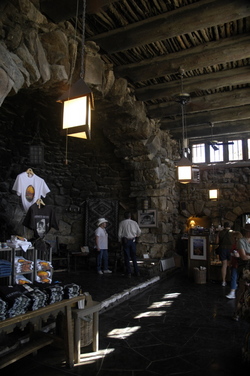
Mary Colter also designed Hermit’s Rest, another fascinatingly unique structure about eight miles west of Hopi House. Like all her buildings, it seems to grow from the landscape, and it immediately invites you in to the cool shady overhands. A massive fireplace dominates half the space. It incorporates earth-sheltering, solar design, clerestory windows, and stone construction.
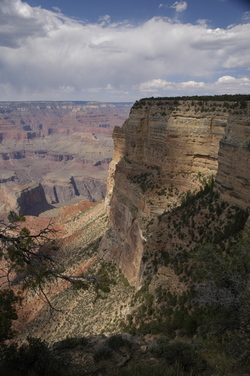
Mary Colter’s story is more amazing when you consider the era in which she did her work. Despite being a woman at a time when women weren’t expected to rise to power, she was the dominant force behind the Fred Harvey and Santa Fe Railway company’s hotel building efforts for decades. She designed several magnificent structures at Grand Canyon, and all over the southwest, many of which are still in use today.
I bought a book published by the Grand Canyon Association about her work, and it is a fascinating look into the times and the architecture. It’s called “Mary Colter: Builder Upon The Red Earth.” It’s available in the book stores here at Grand Canyon, but you may have to hunt for it if you want to buy it online or used.
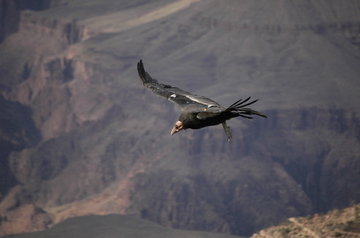
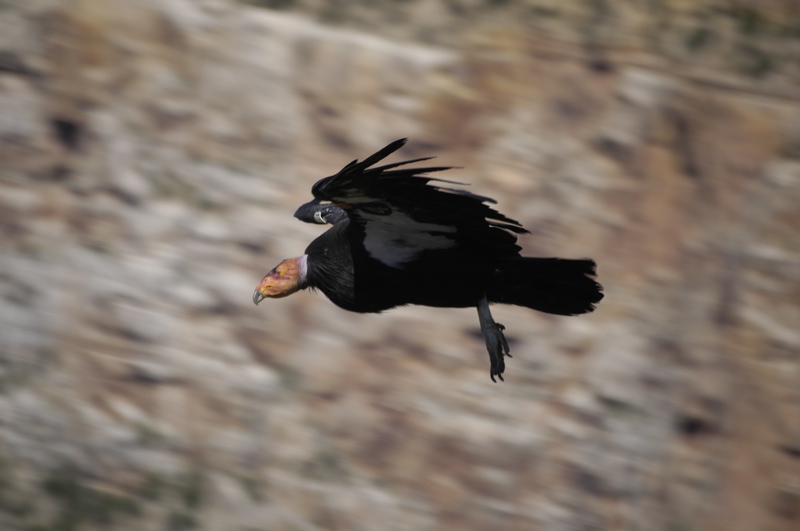
After a full day of hiking we returned to the patio at Bright Angel Lodge to watch the condors again. We met up with a few new friends from yesterday (other photographers) and I got some better pictures. I’ve learned that to capture the condors you need a shutter speed above 1/500th at a minimum.
Today we are moving on. It is a shame to leave after only three nights, but the Grand Canyon will call us back next year. We are just getting to know this place a tiny bit, and I can see that to make our acquaintance better we will need many visits. Just the story of one person (Colter) who contributed to this park is enough to keep me occupied for a while; I can only imagine the thousands of other human stories here waiting to be heard.
May 31, 2007 at 6:41 pm · Filed under Uncategorized
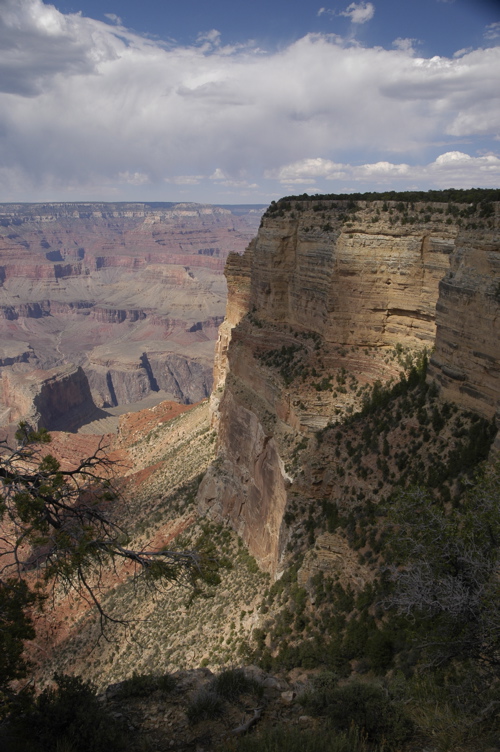
Our walkabout on Wednesday turned out perfectly. The Grand Canyon is far from being just a “big ditch” as I’ve heard people cynically describe it. It has been a place of surprises and learning for us. Our route has been the Rim Trail, an easy paved walk that offers spectacular canyon views every step of the way. We picked it up where we left off on Tuesday afternoon and moseyed our way westward, stopping often.
Everything along the Rim Trail is worth investigating. The Grand Canyon is one of those older western parks that is developed with man-made overlooks, lodges, and restaurants, so the paved portion of the Rim Trail is not a place for quiet solitude, but it is accessible to just about anyone. Tired? Sit on a bench or catch the next shuttle bus. Hungry? Drop in on one of the many restaurants. Overloaded with scenery? Hit one of the four or five shops. It’s as easy as Disney World.
Fortunately, there’s still a lot of Grand Canyon that isn’t highly developed. And for those who don’t go to national parks for the eating and shopping, the historic architecture along the Rim Trail is fascinating. The Hopi House, El Tovar (lodge), Kolb Studio, and others are examples of the innovative architectural styles explored in the western national parks in the late 19th and first half of the 20th centuries. They reflect a mix of Adirondack style, western style, Fred Harvey, and Victorian style all at once.
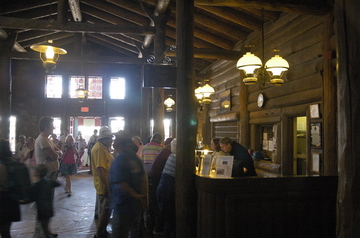
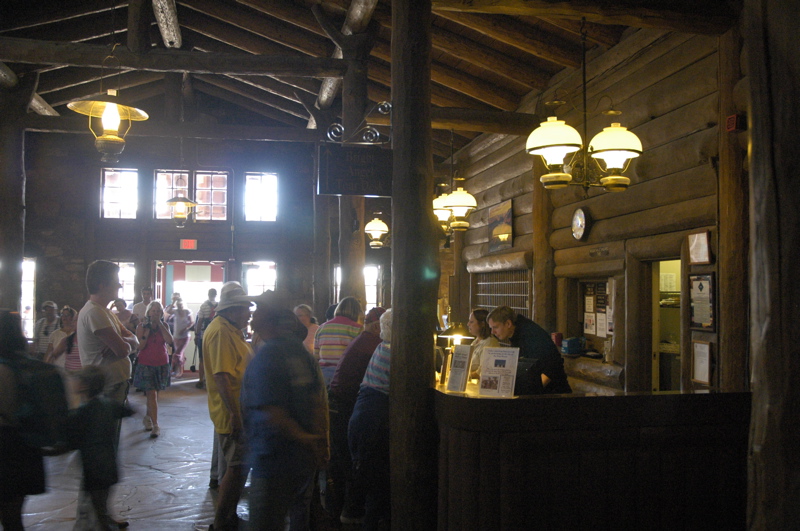
Bright Angel Lodge
The Adirondack/Victorian mix, called “Parkitecture”, is particularly well demonstrated by El Tovar. It’s the classic brown wood style that is associated with state and national parks developed by the Civilian Conservation Corps in the 1930s. You’ve seen it, I’m sure. We’ll have an article on how Parkitecture came about in the Fall 2007 issue of Airstream Life magazine, coming out in August.
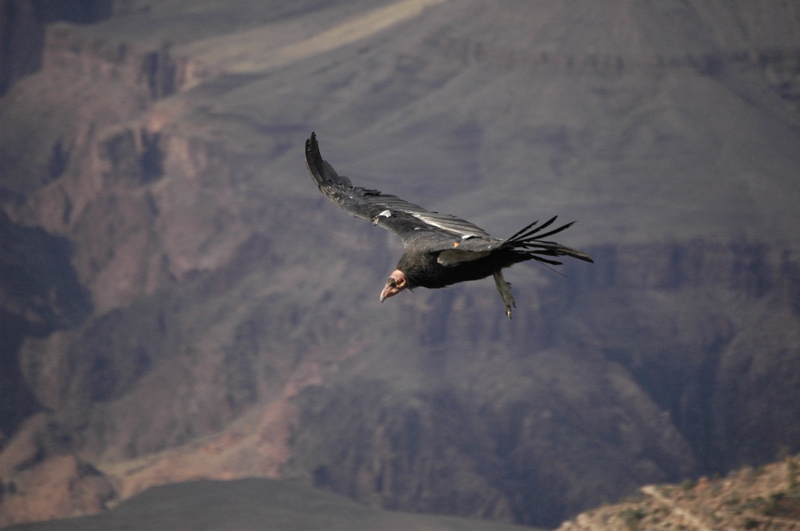
Near the Bright Angel Lodge (circa 1880s and still in use today), we began to spot California Condors soaring over the canyon. It turned out that a dead Bighorn Sheep was down in the canyon and the condors, being scavengers, were showing up in big numbers.
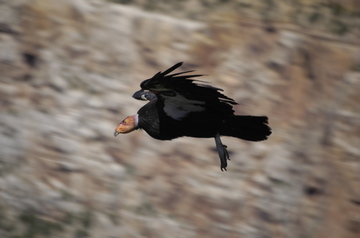
These massive birds with their nine-foot wingspans are ancient relics. They survived mass extinctions on the planet over two hundred million years ago when thousands of other species died, but today they are a highly endangered species. Lead poisoning, attacks by humans, and collecting of eggs by scientists contributed to their decline.
All of the California Condors alive today are tagged and known because the entire remaining wild population (22 pairs) was taken into captivity in 1987 in a last-ditch attempt to save the species. They did well in captivity and now over 200 are roaming California and Arizona. A lot of them are here at the Grand Canyon right now according to the guy who tracks their radio tags, and the best place to spot them is from the patio at the Artist’s Studio, just west of Bright Angel Lodge.
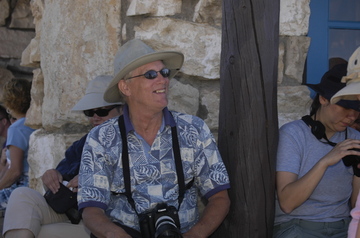
That’s where I ran into half a dozen other photographers, including one fellow who is writing a book on them. He’s snapped photos of all but ten of them. I surveyed the photographers and most were using fast 70-200 Canon zoom lenses, some with multipliers for effective lengths up to 320, and some with image stabilization. I was using my slower 55-200 Nikkor zoom, with no multiplier or image stabilization and finding it difficult to get good shots, but I did manage a few OK ones.
The condors kept us entranced for over an hour, and then we caught a Ranger talk on condors, and then Ranger walk on fossils. Emma loves fossils, and she spotted numerous brachiopods (shells), as well as coral and sponges. Grand Canyon isn’t a major place for fossils but there is a spot right off the Rim Trail to find thousands of them.
Emma’s Junior Ranger book is just about full. She has completed two ranger programs and one campfire program, hiked, spotted all kinds of plants and wildlife (including an elk that wandered by our camp last night), written a haiku, and written her impressions of the park ( “I feel amazed and relaxed. The air smells sweet.” Etc.) We’ll drop it by the Visitor Center at some point today to get her badge.
With all of the stops we made, our total hiking distance yesterday day was less than three miles, but it was a very full day and both Emma and I returned with full memory cards in our digital cameras. Today we will do the same, walking the less-developed and unpaved section of the Rim Trail toward Hermit’s Rest, to see how else the Grand Canyon’s rim can surprise us.
May 30, 2007 at 8:50 am · Filed under Places to go
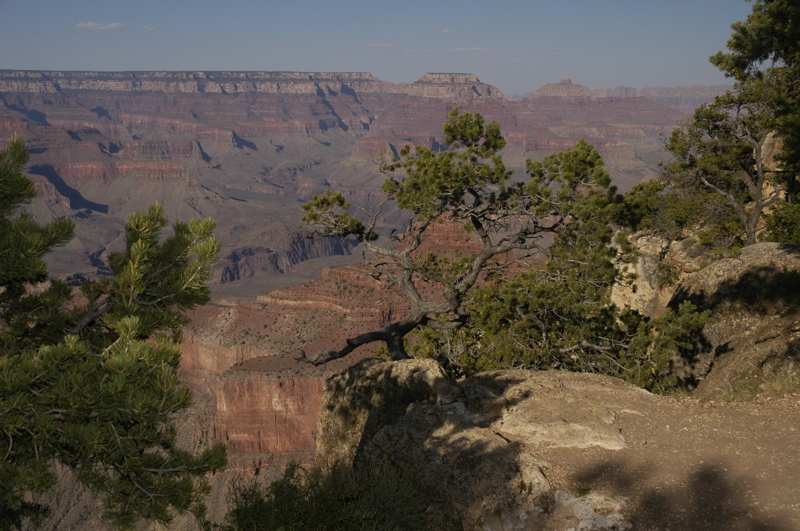
It is amazing to come to a national park after having seen so many incredible national parks, and being blown away once again. That’s the amazing thing about America’s national parks. They are all worth a visit. We just can’t get enough of them.
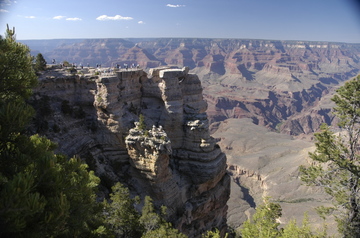
Grand Canyon is, as we expected, spectacular and inspiring. I really want to go for a hike down into the canyon to the Colorado River, and camp for a night or two at the bottom, but that’s not possible in this short visit. Also, I’ve been told that you need to make reservations months in advance for the mule-camping trips. We’ll get the lay of the land on this three-night stay and plan another long trip for next year.
We’ve gotten a small taste of the south rim so far, by hiking part of the Rim Trail, riding the shuttle bus around, attending a campfire program, and starting Emma’s latest Junior Ranger program. Today our plan is to browse the rest of the Rim Trail, drop in on everything along the way, and attend a Ranger Talk. No rush, just a leisurely walkabout.
The altitude here means a few adaptations. We’re at 7000 feet and so it cools off quickly at night. Last night it dropped into the 40s. Also, we all felt a little tired at first, which is a result of the thinner air. Based on our experiences last summer at high altitude in Colorado, we should adjust quickly.
The “Trailer Village” (the only place in the park with hookups for campers) is not particularly attractive, but it is very convenient and has all the amenities (store, full hookups, even cable TV!) We’re not spending much time at the Airstream, however. It’s easy to hop on the LNG-powered bus and get anywhere in the park in just a few minutes.
Our reputation seems to precede us. Only a few minutes after arriving, one of the park volunteers drove by and said, “You’re that Airstream Life guy!” Turns out she knows David Tidmore of Roger Williams Airstream and has followed the blog. Another “small Airstream world” story.
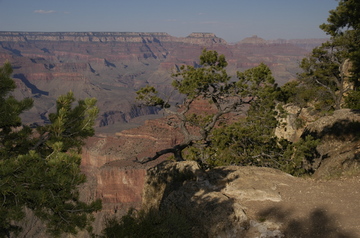
(As with most pictures on the blog, you can click these to see a larger version.)
This blog entry comes to you courtesy of someone in the campground with a satellite connection and an open wi-fi signal. Thank you, “WhitewaterVideo”. When we are camped in a remote spot and our Verizon cellular Internet system works, I always leave my wifi open for others to share, and it’s nice that someone has returned the favor.
« Previous entries ·
Next entries »