March 26, 2007 at 9:00 pm · Filed under Uncategorized

I thought this picture from today was analogous to many things we’ve done in the past two years. Selling the house, full-timing, picking a new place to settle, and now the real estate question. Sometimes you’ve just got to take a giant leap and hope for the best.
Of course we look before we leap. Although it may look to outsiders that our moves are random or oddly motivated, in reality moderation is our goal. We just happen to believe that conventionality should also be in moderation…
Likewise, a lot of people who have written to us and said, “I hope to do that someday!” I hope you do, too. For some of you, the stars will align and the right moment will be clear. But for most, there won’t be a clear sign and at some point you will just have to make that leap, perhaps walking away from a perfectly good job, house, or neighborhood to take an adventure whose outcome is not guaranteed.
Emma’s leap of the day was to get re-acquainted with the deep end of the swimming pool. Leaps like this are the outward signs of having conquered fear, which is always a great thing. Something to think about. Have you taken a leap lately?
March 25, 2007 at 7:19 pm · Filed under FAQs
As we consider the goal of having a home base, we’ve been tallying up the cost of this little luxury. This may be helpful — in reverse — for those of you considering full-timing in an RV, to see how much you’ll save if you sell your house while you’re out, like our friends Bobby & Danine.
Petey gave us an article that appeared in the Wall Street Journal, March 12, 2007, by David Crook, entitled, “Why your house isn’t the investment you think it is”. You may be able to find it online but I think you need a subscription to read it. The essence of the article was that houses are inefficient or even bad investments. Although people think they make money when they sell, in most cases they actually lose money when the cost of maintenance, taxes, insurance, and interest are factored in. Mr. Crook calls the check you get when you sell “a partial rebate” of what you spent, not a windfall or profit.
I looked at the numbers for our last house and found he’s right, at least in our case. It looked like we made money on our house, but we actually lost money. We actually would have been better off not building on the land we bought, renting for the eight years we lived in the area, and then selling the land — no kidding. For most people, it turns out, houses are something you buy because you want one, but from an investment standpoint you’d be better off putting money into rent and a mutual fund. It varies a lot from one local market to another, of course.
This naturally dampens our enthusiasm for having a “home base”. Financially, it’s pretty darned risky to plunge back into the real estate market when we don’t expect to be here for more than 7-9 months per year. It’s a huge luxury compared to the lightweight and inexpensive lifestyle of full-timing in the Airstream.
Our “housing” expenses, as full-timers, amount to $400-600 per month, plus an amortized $500 per month for the trailer itself. That includes our campgrounds, utilities (water, sewer, and propane), and maintenance. We don’t pay property taxes, or for garbage pickup, electricity (except this rare moment while we are staying for more than a month), cable TV, lawn mowing, Home Owners Association or condo association dues, etc.
This stuff is probably ho-hum to you, but we’ve been on the road so long that all of the expenses associated with owning a house seem outrageous to us now. Since we sold our house two years ago, we have become used to putting money in the bank account and having it stay here. I had forgotten how invisible forces seem to suck it all out when you have a house to feed.
So why buy? There are a few reasons still left:
1) We have a child. She is doing wonderfully in our homeschooling program and we love the time together, but we’d like her to have more friends and at least a test of traditional school for a year or two. We never intended to be full-time travelers forever.
2) Health care. Continuity of care is important when you have any sort of chronic illness. We’re pretty healthy right now, but there have been a few things to remind us that this can change. If one of us gets really sick, we’ll want to park somewhere and deal with it. Having a home base makes that easier, since we’ll already have known physicians and facilities to go to.
3) For people who are only going to full-time for a short period, hanging onto the house may be the smartest choice. The cost of selling (broker’s fees) and the cost of re-acquiring a house (closing costs, market appreciation) can be more than the cost of just keeping the old homestead.
4) Satisfaction of ownership. Sometimes, you just want to have a “nice” house and feel like it’s really yours. If owning a house is a big part of your self-image and makes you feel good, that’s a reason to have one that transcends financial matters. But I’d recommend that frequent travelers or full-timers be honest with themselves and acknowledging the house for what it is: a luxury, not a financial decision.
Renting is also a good option. In our case, renting an apartment or house would probably be cheaper than buying for the short term, so a big part of the buy/rent decision will be our willingness to commit to the area for several years, at least. Having an Airstream to let us travel (and spend summers in the cool northeast) makes that commitment easier.
This is a work in progress … we’ll let you know how it goes …
March 24, 2007 at 9:54 pm · Filed under Uncategorized
Every time we are in the real estate market I am always amused by what agents and sellers will say to market their properties. I know hyperbole is part of the game, and the goal of real estate listings is to get people into the houses, but still once in a while there’s a real doozy that makes you shake your head and say, “What the heck were they THINKING?”
Case in point: “House has been well maintained and shows well.” Reality: mismatched carpets, brown swimming pool, blue tape on the floor to cover cracking tiles, peeling ceiling containing asbestos, needs roof work, and most appliances are 15 years old. The funny thing is, we actually made an offer on this house but got outbid. (It was a nice neighborhood.)
Another example yesterday: “This house will sell itself. $2000 painting allowance.” Right off the bat you know things are not going to look good when you see an allowance by the seller for repainting. As a bonus, the dog left us fun presents on the carpeting to step around like little land mines. An allowance for carpeting would have been more appropriate.
Then there’s the real estate code. I’m sure if you’ve bought a house you’re familiar with this arcane language. Guarantee: all phrases below are from actual listings.
“Charming” = Small, with stencils on the walls.
“Cozy” = Sized for Hobbits.
“Move-in ready” = Kind of like on eBay when they say “Trailer is ready to camp!” NOT
“Potential” = Needs lots of work.
“Opportunity knocks!” = Prior owner never pulled permits.
“Handyman special” = Bring a bulldozer.
“Rare opportunity” = Priced above market.
“Priced below appraisal” = Nobody wants it.
“Priced below market” = Previous buyer backed out.
“Bring all offers” = We know it’s overpriced.
“View of riparian area” = House is next to a gully.
“A classic” = hasn’t been updated in 30 years.
“Historic” = hasn’t been updated in 50 years.
“Would make a good dog run” = Side yard is bare dirt.
Now, despite poking fun at the listings, I should say that we are extremely happy with the realtor who is representing us. He’s tolerant of our quirks, endlessly patient, and incredibly responsive. There are a lot of “good guys” in the business and we’re happy we found one. With his guidance … and a few small miracles … we’ll find a home base eventually. In the meantime, the MLS will keep us amused. Isn’t that what it is there for?
March 23, 2007 at 9:50 pm · Filed under Uncategorized
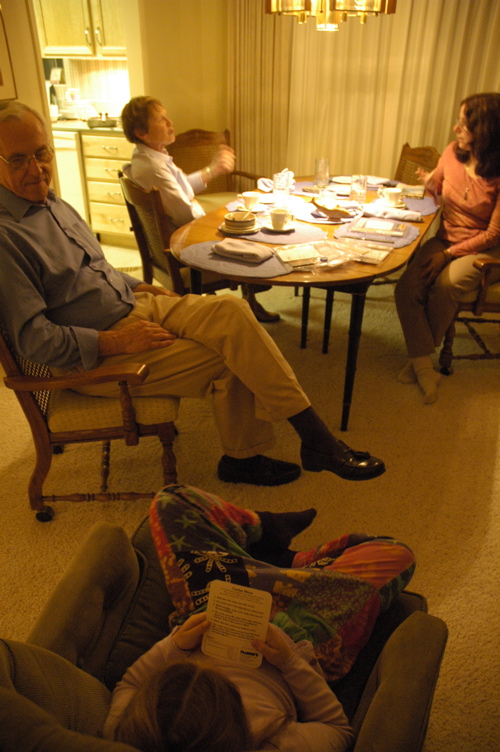
Our pals the Fabers invited us over for dinner tonight. They’re the folks who went with us to Mexico … was it only a week ago? It has seemed like two weeks, which I attribute to the crazy schedule we’ve had since we got back.
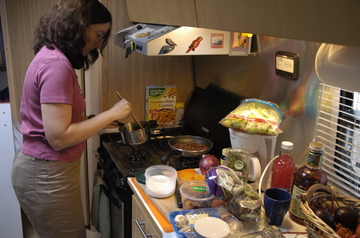
Eleanor whipped up an elaborate salad … containing mixed spring greens, radiccio, endive, bartlett pear, maple-ginger glazed pecans, red bell pepper, mushrooms, balsamic marinated onions, apricots, shredded carrot, and proscuitto. She topped it with a homemade dressing: a balsamic reduction with ginger, apricots, and apple juice.
It was a meal in itself, but of course it was only a complement to Petey’s delicious dinner of marinated pork loin, steamed asparagus, and sweet potato with butter & brown sugar. And then homemade lemon bars for dessert. So, we didn’t suffer.
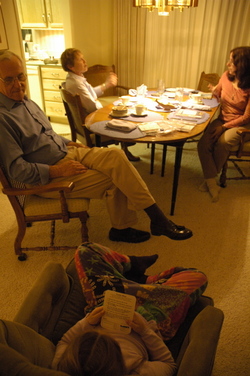
After dinner
We discussed some future trips that we might take … and the Fabers’ plan to be on the 2009 Capetown to Cairo trip. They are already signed up. That’s going to be an amazing trip if it comes off. I’m tempted to go myself but who would run the magazine while we were out of touch for four months? It’s hard enough to get a week off. My boss is strict about vacation time …
March 22, 2007 at 8:55 pm · Filed under Uncategorized
The seasons are changing here in Tucson. We’re getting blustery, wild weather. Yesterday high winds kicked up dust all over town and today thunderstorms kept rolling through.
In other parts of the country these weather events might not seem so dramatic, but here the sky is usually blue and clear. The dust turned it to brown pudding, the storms beat the sky until it was black and blue. It’s a break from the ordinary, and fun to watch because it’s wild but not as forbidding as other parts of the country. Tucson doesn’t get hurricanes, tornadoes are a rarity, floods fill the washes as they are supposed to, and everything usually clears up pretty quickly.
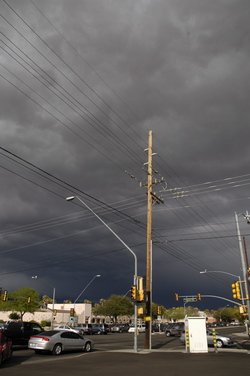
That’s not to say that the weather can’t be dangerous. The dust storms can completely obscure your vision, and driving down I-10 can be risky if one blows across. This evening we had a pretty good lightning show, too. But the rain that fell amounted to a paltry desert portion, enough to wet the ground a bit and then evaporate almost as quickly.
The saguaros and other desert plants will suck up what they can, expand a bit in their pleats like a person after a big meal, and be set for another long spell until the next few precious drops come by. We’ll be looking for desert blooms. We’re expecting a few more days of this weather and then I suppose the heat will return and Tucson’s warm spring will have sprung.
One peculiar effect of the rain here is that it actually can make cars (and shiny Airstreams) dirtier. The rain carries dust from the air down and leaves streaks on everything. I left my bicycle out in the rain a few weeks ago and had to wipe it down with a clean towel to get all the dust streaks off afterward. Dust is a part of the desert life, a symbol of dryness, but paradoxically it turns out also to be the reminder of rains gone by.
March 21, 2007 at 11:11 pm · Filed under Uncategorized
I thought I was a fan of the principles of “New Urbanism”, but perhaps I am a fraud. Or maybe New Urbanism is — I can’t decide.
New Urbanism is a theory of community design that calls for closely-spaced residential developments with planned centers of retail shops and other community features (schools, parks, etc.) The general idea is to develop communities that fight sprawl by giving people most of what they need right in their own little village.
New Urbanism is one of those great ideas that doesn’t always get executed well. During our Airstream travels we’ve visited several New Urbanist communities, including Celebration FL, Seaside FL, Denver’s Stapleton, and Civano here in Tucson. All of these places have their distinctive features and advantages, but of them all my favorite is Stapleton. It has real diversity and the community seems well planned.
Seaside is marvelous too — you might have seen it in the movie “The Truman Show” — and it even has a couple of Airstreams in town, converted to retail shops. One, I believe, sells sushi. But if you don’t have big bucks don’t even bother asking about living there. This sort of belies a principle of New Urbanism, that it should incorporate a mix of affordable housing. Once upon a time there was affordable housing in Seaside, but not any more.
This sort of thing is on my mind because we are so busy looking at real estate. Today we checked out Tucson’s new Armory Park Del Sol which is an urban infill community that draws on New Urbanist ideals. Armory Park Del Sol’s big claim is energy efficiency — every house is well insulated (a rarity in this climate) and they all have solar panels on the roof.
But this development fell into the trap of so many others before it. Originally housing was supposed to be available at the affordable rate of $80,000 but by the time it got through the development process that vanished. We found one resale on the market, and at $265,000, it is one of the cheaper units available.
We also spent 40 minutes driving slowly through Civano, and noting all the properties for sale. I hate to admit it, but despite my intellectual interest in New Urbanism, I just can’t get psyched about Civano or most of the other New Urbanist communities. On one hand, I’m always disappointed when I visit the communities and find that the core principles are eroding or were never there: affordable housing, a mix of housing styles, energy efficiency, traffic calming, parks, walkability, discernable centers, etc. The pressure of local real estate seems to overwhelm the ideals of the developers.
On the other hand, I find that being a boy from a rural state, the crowded nature of New Urbanist communities gives me claustrophobia. So even if I found the ideal community, I might not buy into it. Again, Stapleton is the exception because of its broad open central park. Does this make me a poseur, just another guy who talks the talk but can’t walk the walk?
But perhaps it’s not just me. Have you noticed two contradictory trends? RV travel and ownership has risen dramatically since 2001, and yet most new communities (of any type, not just New Urbanist) don’t have any provision for allowing homeowners to keep their RVs nearby. To make matters worse, they usually ban RV parking entirely. (This is because RV’s are considered an eyesore, in the same category as rusty old cars on blocks. Sadly, many RV owners agree with this — except where their own rig is concerned. Then it’s the most beautiful thing they’ve ever owned.)
This means that an increasing number of people are effectively exorcised from buying into certain communities. Buying a home where we can’t have our Airstream nearby and ready to go would be like buying into a “55+ community” and just seeing Emma on weekends. The Airstream is a member of the family!
So while I still want to believe in the concept of New Urbanism, it flies in the face of my reality, at least as it is executed in most places. Can’t we live in a nice community where RV parking is allowed at least in a dedicated lot nearby? Can we dwell in a planned village, walk to “town”, have bicycle- and pedestrian-friendly streets, and still own a travel trailer? I’d like to believe we can, but so far we are not finding anything that meets the challenge, at least not here.
Compromise is the nature of real estate shopping, and I fear that in our case the compromise will mean our Airstream taking an back seat. Poor trailer. By the end of this summer it will have been our home for two years, and it will be hard to put it away, even temporarily. Perhaps in the next few weeks we’ll find the ideal home where it can stay with us, gleaming in the side yard and reminding us of adventures yet to come.
March 20, 2007 at 9:01 pm · Filed under Uncategorized
In between other big projects, like organizing articles for the Fall magazine issue and reviewing layouts for the upcoming Summer issue, I’ve got a little time to work on the book project again. It’s going well, and I think I’ve finally found the right voice for it. I’ll know for sure in a month or two.
We’re also trying to make time to look at houses, which could be a full-time job if we let it. On Monday we reviewed about two dozen online, went into one, and drove by about a dozen more. Still looking…
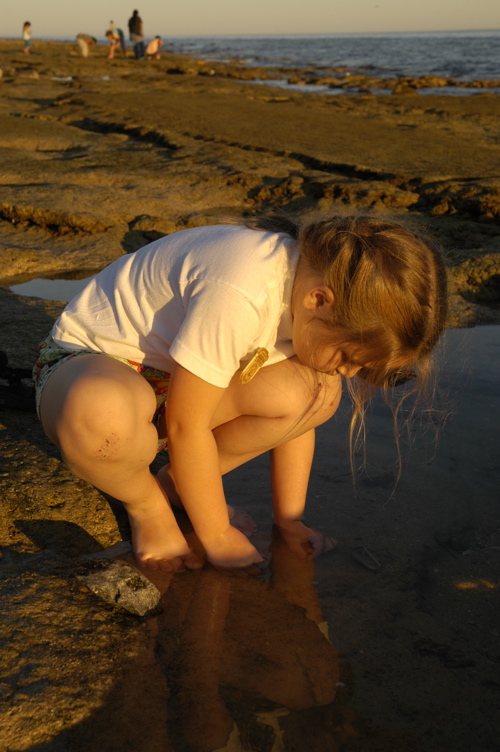
So with all this work going on we haven’t had a chance to have any adventures the past few days. I’ll flash back to last week in Puerto Penasco. Down by the beach, the low tide reveals tide pools in the volcanic basalt, and these are filled with interesting sea creatures. Petey proposed that Emma collect some sea water, sand, and a few hermit crabs for study. (They’d be released when we leave.)
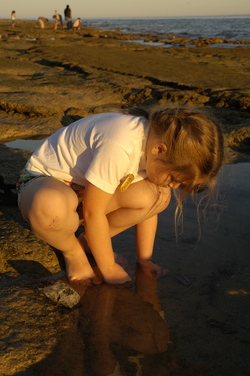
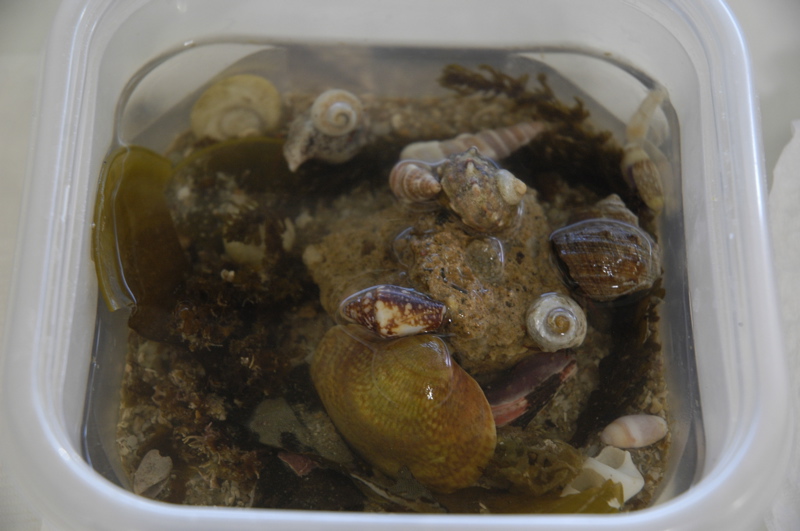
A resealable plastic container was all we needed to make a miniature temporary aquarium for a sampling of tidepool sea life. Emma collected a layer of sand, some rocks, a little seaweed and four tiny hermit crabs, and with those simple elements we had a miniature salt water ecosystem right in our Airstream trailer. Petey, the grandmotherly instigator of this idea, added a few shells for decoration.
Life in the tidepool is more dramatic than you might think. Several of the hermit crabs began to do battle with each other, and before the evening was out we realized the “empty” shells turned out to have more hermit crabs, prompting Emma to suggest thinning the ranks before we had a fatality.
The next morning Emma was delighted to find that the water contained much more than just crabs. Tiny brine shrimp could be seen flitting around in the shallows, and in the corner a tiny white creature that looked like a miniature sea anemone was actively exploring one corner of its world, ingesting and regurgitating samples of sea water and brine shrimp. Suddenly our little plastic dish was an entire world.
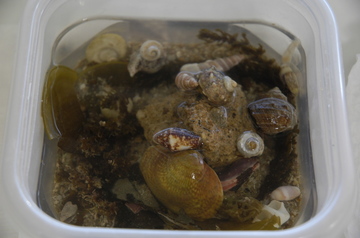
The hermit crabs were transformed from a home natural science project to temporary members of the family during our three days in Mexico. Emma named them all, and it was with great regret that she returned them to the tidepool on Friday.
Emma learned a little about life in the tide pool from this. We could all see the crabs foraging for food, establishing their position in the crab hierarchy, and co-existing with the other living things in the water. Each day the water needed refreshing, which was a good reminder of the needs of pets, too. I plan to point that out when the request comes for a puppy.
If there is an ideal pet for a few days in the Airstream, I will have to vote for hermit crabs again. They are silent, easy to care for, cute, free, hypoallergenic, they require no special equipment, and they have a built-in time limitation (once you leave the beach, they have to go).
« Previous entries ·
Next entries »