March 19, 2007 at 9:18 pm · Filed under Uncategorized
We’re back in Tucson for a while, back to work and once again looking at houses. While we were on vacation last week I had a chance to think about what we are doing and where we are headed. Here are a few thoughts I compiled while parked in Mexico:
Full-timing is not very much like camping most of the time. Most people who buy camping trailers look forward anxiously to the weekends and holidays when they can break away to a favorite quiet spot in the greenery of a forest, or in the blazing sunshine near a beach or in the desert. For them, the trailer represents the dream, and they can often get a thrill just to see it waiting in the driveway ““ a symbol of their freedom to come.
For us, living in the Airstream, every day is a day in the trailer, and although I still like to look at it, we have to make a special effort to separate the working days from the vacation days. In the past year I’ve been working a lot, six or seven days a week, and limiting my time off to a few hours each day in between sessions at the computer. My friend Dr. C pointed out that I have learned to be a supreme juggler, keeping work, parenting, wife, trailer maintenance, travel, blog, and various other projects all going at once, but the good doctor also pointed out that this may not be a healthy long-term strategy.
So part of the idea behind taking a full week to completely disconnect in Mexico was to regain perspective on the life we’ve been leading and to really enjoy some “camping” instead of just “living.” For us, camping means no obligations, no schedule, no email or cell phone. We just get up in the morning and do whatever feels right. Some days, that’s a walk on the beach, and other days like today, it’s writing down the reminisces or even defrosting the freezer.
That’s what Eleanor was inspired to do this morning, and I won’t ask why because an unspoken rule of our vacation time is to not question the why but simply go with the impulse. She doesn’t ask why some days I head straight to my computer to write down fresh ideas, and other days I go for a walk. Having to explain yourself is work, and we’re avoiding work, whereas if you really feel like defrosting the freezer in Mexico it may be your idea of fun at that particular moment.
Having had a few days to reflect without the barrage of emails that I normally respond to each day, I’m starting to see that some minor lifestyle changes are needed. That’s no problem, since our program and itinerary has been undergoing constant change since we started traveling full-time. Eleanor and I have been discussing the nature of our future life together for several months now, recognizing that we want to give Emma the option of “regular” school for a while at a fixed home base.
But it’s not easy to make the decisions. Emma may do better homeschooling than in public school. And back in December, Eleanor felt she was done with full-timing and would be happy to get into a house again. When we started looking at houses in earnest, the realities of house ownership struck hard (expense, obligation, worries, possible boredom). Suddenly these factors made another year in the Airstream look better and better.
I was wondering if this phenomenon was unique to us, so I talked to a few other full-timing couples who were getting “off the road” or had recently done so. They all reported the same thing: the prospect of sitting still was unappealing and one couple had even left their new house and gone back on the road for three months. In short, full-timing can ruin you. Home ownership no longer has the appeal that it once had, and can even feel like an unnecessary burden.
Still, a home base would be nice for practical reasons. Our compromise will probably be a very lightweight piece of real estate, either a condominium, small low-maintenance house, or even an “RV port” which is a sort of garage apartment that would store the Airstream and add extra living space.
One decision is certain: After we have the home base established we will continue to travel extensively. My job requires it, but also we love it. The Airstream gives us a second home, one with a huge advantage over the vacation timeshares and condos we’ve seen. The Airstream has wheels, and that means we have a second home anywhere we care to pull it. So most likely we’ll spend summers in the northeast, enjoying the fine weather there and avoiding the scorching heat of the southwest.
Speaking of scorching heat, blog reader Rita asked a question about how our fridge and other electronics fared in the hot weather we occasionally encountered in the past week. The short answer is that things like computers, cameras, etc., were fine. The refrigerator warmed up a bit, but running the new dual cooling fans we had installed at Roger Williams Airstream last January seemed to help. With the fans running and ambient air temperature around 100 degrees, the refrigerator stayed around 44 degrees, which is fine. As the weather warms up here in southern Arizona, we should have a few other chances to test the fans again.
March 17, 2007 at 11:15 pm · Filed under Uncategorized
It was a wise move to abandon Spring Break Land for Organ Pipe Cactus National Monument. We got a good night’s sleep for a change. I didn’t want to come back from vacation feeling run-down. And the advice I got about not staying in Puerto Peñasco turned out to be very wise. Even as we were hitching up in the middle of the day, the campground was emptying out of people over 30, and their rigs were being replaced by elderly trailers dragged in by tractor. The campground rents those old beaters to the college students, and our trailer was quickly being surrounded by them. It didn’t bode well for sleep.
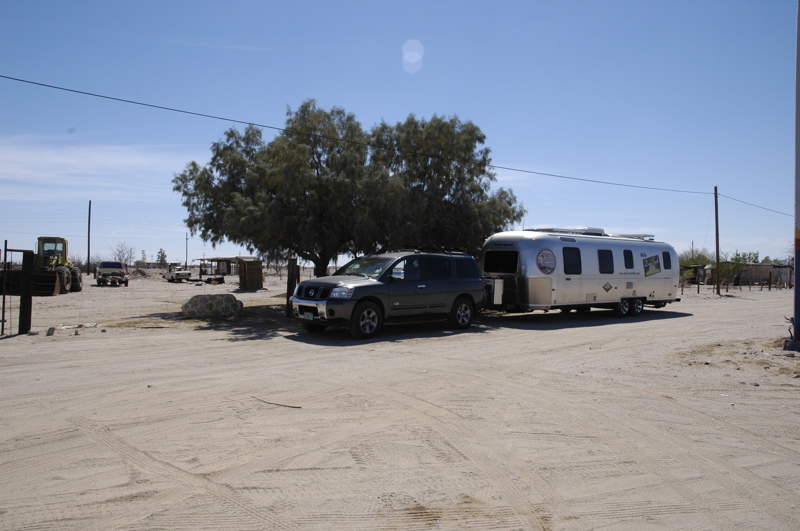
Beside the Sea of Cortez the temperatures are much more moderate than in the Sonoran Desert heading north (which includes Organ Pipe Cactus National Monument). We left Puerto Peñasco in the low 80s with a slightly damp sea breeze, and 30 miles north when we stopped for lunch it was 108 and utterly dry. Fortunately, we found shade from a tamarisk tree in a roadside pull-out by a small ranch.
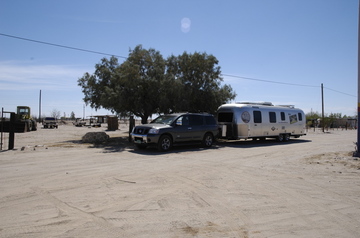
Lunch stop in 108 degree heat
At this point on Mex Hwy 8 there is a sister park to Organ Pipe, called El Pinacate y Gran Desierto de Altar, but everyone just calls it Pinacate (PEEN-a-kot-tay) for short. We stopped into to the visitor center at Km 51, but the gate was closed and nobody was in the visitor center. The door was open so I picked up some info and read the signs as best I could (they’re all in Spanish). Bert Gildart will be writing an article for the magazine about the Sonora Desert and I plan to contribute a sidebar about Pinacate. It’s an interesting place with a huge volcanic landscape, numerous cinder cones and lava tubes, a large bat population and much more.
Google Earth location of our lunch stop. Note to the west of our stopping point you can see the volcanic shield of Pinacate.
US Customs turned out to be no big deal. We waited in line for about 20 minutes, then had a one-minute interview with an amiable agent and we were on our way without even an inspection of the Airstream. The agent claimed to have seen Airstream Life magazine but I think he was pulling my leg.
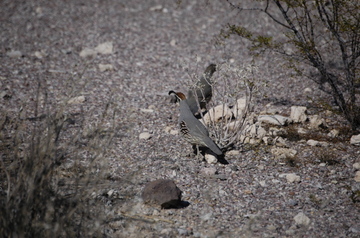
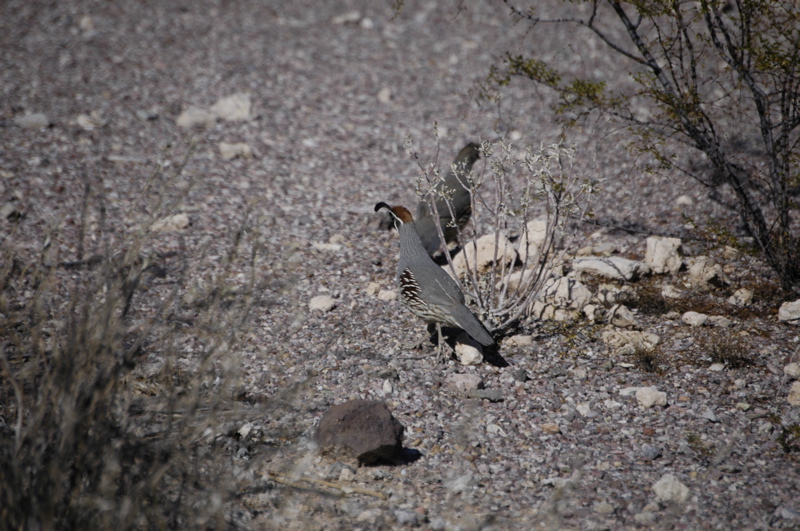
Gambrel’s Quail in the campground
When I said in an earlier blog we’d be back to Organ Pipe I wasn’t thinking quite so soon, but we were all glad to be back, even with temperatures running about 100 in the afternoon and no air conditioning. It was just too obnoxious down in Puerto Peñasco, and this place is an antidote of peace and quiet. The only sound last night (other than the amusing ranger program, which was a sing-along of cowboy songs) has been the yipping of coyotes in the distance.
We pulled out some of our tricks for handling extreme heat. These include soaking our shirts in water, running all three Fantastic Vents, drinking lots of cold water, eating ice pops, soaking our feet in a pan of water, and napping. By sundown at 6:30 p.m., the temperature was a bearable 90 and after the ranger program it was 80 outside and dropping. With plenty of water, you can stay comfortably cool in almost any heat.
March 16, 2007 at 10:57 pm · Filed under Uncategorized
We have decided to pull out of Puerto Peñasco a day early. Frankly, we’re disappointed in it. We knew going in that it was a tourist town mostly for the benefit of Arizona residents, but we hadn’t anticipated how much they would have overrun it, and thus altered it.
The Spring Break mobs are becoming too much to bear. Their antics are taking the “family” aspect out of this town just as they have at southeast US beach towns. I think other people knew what was coming, because our campground got quite a bit emptier yesterday. Coincidentally, Ken & Petey left to spend a night at Organ Pipe instead, which in retrospect would have been a good move for us too.
During the day things are not bad, but as the weekend approaches the streets are getting more crowded and noisy with students roaring around in barely-muffled ATVs. It gets more lively in the evening, when the loud explosions from cherry bombs and firecrackers start. (This is such a problem that several campgrounds and beaches are posted against fireworks, but I have seen no enforcement.)
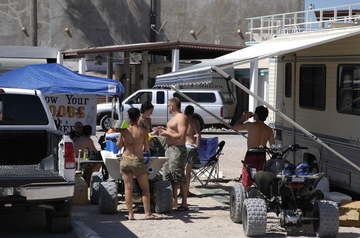
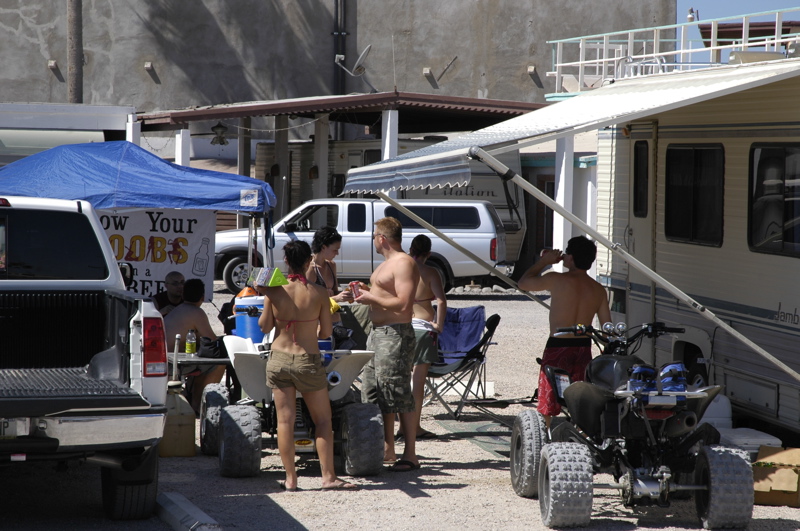
Our neighbors have erected a large vinyl banner that says, “Show Your Boobs ““ Win A Free Beer,” and set out a couple of large ice chests in anticipation. We’re not so prudish as to be bothered by the suggestion (I was mostly amused), but we were wondering if this was going to mean more noise right next to us. As it turns out, the males in question got no takers from the general public.
The music last night from the nearby bars rose to an unbelievable level, and gaggles of students were walking past our trailer all night, talking loudly. They also came and went using the extra-noisy rental ATVs. Sleep is harder to get each night. During one of our many nighttime awakenings, Eleanor was treated to the sight of a student barfing in the space next to our trailer at 4:30 a.m. This morning the seagulls arrived to clean it up.
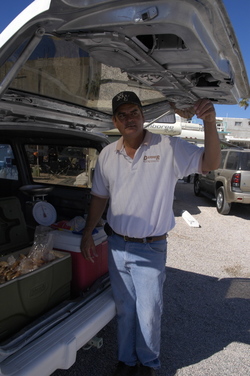
I bought three pounds of jumbo shrimp ($20) from the fellow who drives by every day, and he told me this weekend would be worse. Two thousand students are expected to arrive. “This is not a weekend for you to be here, amigo,” he told me kindly.
But the students are only part of the reason we’re going to head out. Puerto Peñasco is a pleasant enough town but it is being turned into something more like Cancun, with elaborate resorts along the water and plenty of programmed distractions (cruises, parasailing, fishing trips). I can see why people come to Puerto Peñasco, and it’s not a bad place, but it isn’t why we came to Mexico.
We want to explore Mexico to see the historic towns, ancient ruins, deep canyons, volcanoes, open-air markets, meet interesting people with different lifestyles, and to try local foods. The little authenticity this town has is being wiped out as quickly as possible, and the locals are mostly working on construction of new condominiums.
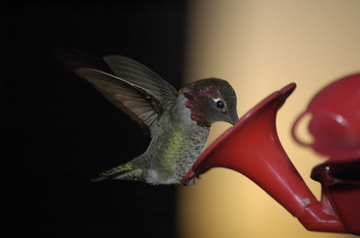
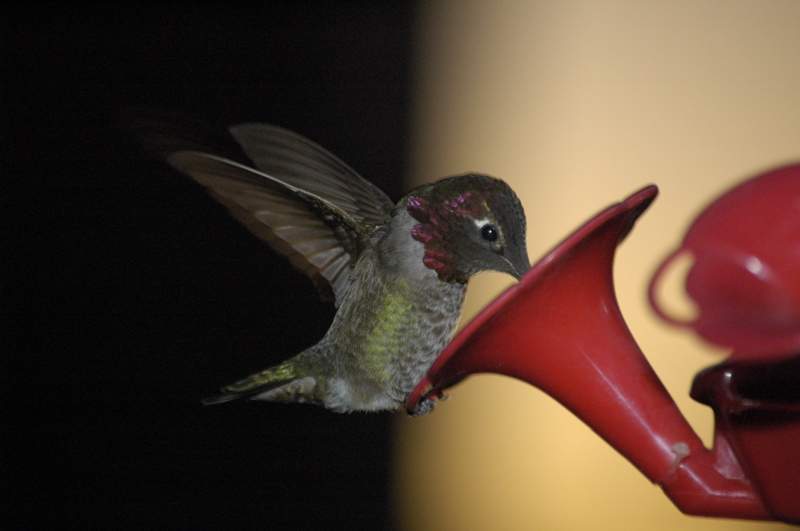
Hummingbirds in the campground
Still, the trip is not a failure. We’ve learned about this small corner of Mexico, and practiced a little Spanish. I got a break from work, and it has been relaxing (to the point of boring lately). Most importantly, we have gotten some experience with Mexican travel. I don’t think Puerto Peñasco prepares one for the “real” Mexico anymore than a ride on the flume in the Mexico pavilion at EPCOT does, but still the trip has served to give us a good trial run.
It is most ironic that people warned us about traveling in Mexico because of the perceived problems with Mexicans, and yet our disappointments have been entirely because of Americans. It’s also ironic that people said crossing the border would put us in a lawless zone, and in fact there seems to be more danger ““ at least in Arizona ““ on the US side of the border where the drug runners are hiking through the desert to make their drops.
We’ll be much better prepared for a long trip down Sonora either later this spring or next fall. Next time I will bring a few gadgets: a good quality surge protector that protects the entire trailer electrical system; a funnel that makes it easy to pour a 5-gallon water jug into the trailer’s water fill; a plug-in voltage meter that I can leave on all the time. Other than that, our normal complement of equipment is more than sufficient.
The funnel is because bottled water doesn’t pour into the nearly-vertical water fill opening on the trailer ““ it mostly spills. I miss the water fillers Airstream used in the 1970s that could easily be filled from a bucket. Eleanor and I improvised a funnel by cutting open a plastic milk jug, but I think we can come up with something better.
Buying purified water for our fresh water tank is a reasonable strategy, since it is apparently readily available, but it does make for expensive showers. It also gives us a chance to interact more with locals. For example, the water truck didn’t show up yesterday, and when I inquired at the office I found out that it only comes once a week, not daily as I thought. It was less than a mile down one of the town’s dusty roads to the water/ice plant, where I bought a 5-gallon jug using my pigeon Spanish (agua, grande, ¿cuánta cuesta?, gracias). In the final analysis, it was more interesting to buy at the agua purificada factory than it would have been to have the water delivered. Such moments open the door to meeting people, and in our travels we’ve found the chance meetings are often the best.
March 15, 2007 at 9:33 pm · Filed under Uncategorized
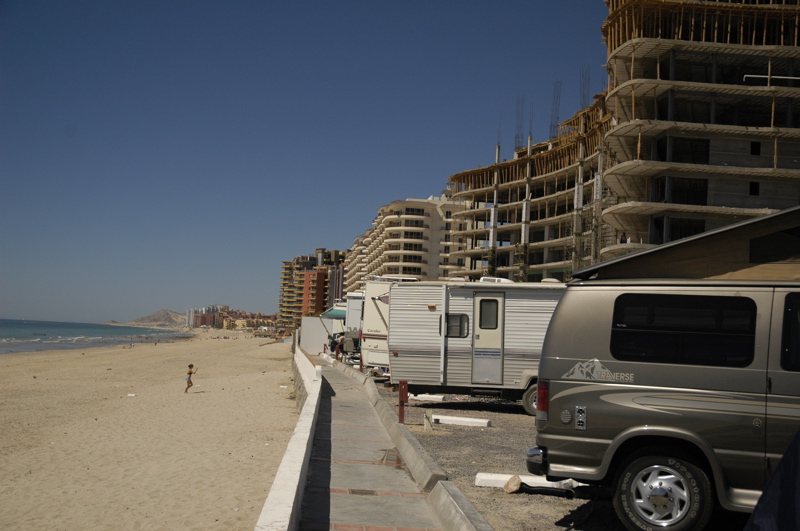
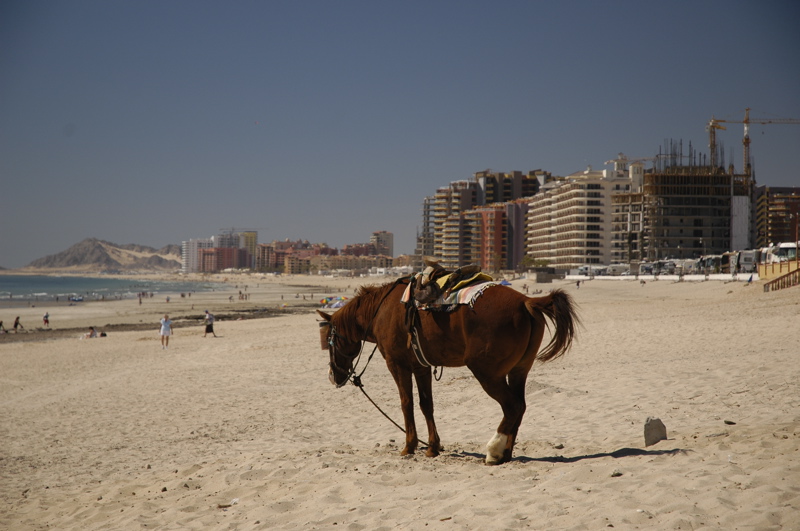
The scourge of Puerto Peñasco is condominium development. The north shore, called “Sandy Beach” is being completely covered by high-rise buildings, each offering a more “luxurious” living experience than the next. You can see the billboards along Rt 8 as you drive into town. These developments are primarily for Americans, and each one has a Sales Office, a gang of real estate agents, and a model home NOW OPEN, just like US condo developments.

Condos going up along Sandy Beach. Click for extra large view.
The pace of real estate development in Mexico is quite a bit slower than in the US, and apparently hazardous. All over town there are remnants of projects begun but not finished. Skeletons of steel framework, foundations poured over sand, lots cleared of their original modest structures but now accumulating only garbage, tattered and faded signs promising exciting new homes “coming soon” “¦ all of these things suggest a boom-or-bust mentality, and to the skeptical real estate investor they spell Buyer Beware. It would be very dangerous to take advantage of “Pre-construction pricing”, given that the construction phase might never be completed. A few people that Ken & Petey have talked to are caught in exactly that bind. Their condominium is three years behind schedule. Mañana “¦
Still, at least half a dozen major projects are underway on Sandy Beach, and several are already open. Nearby is Playa Bonita RV park, one of the nicest in town, similar to Playa de Oro but facing a nicer stretch of beach and some frankly beautiful views.
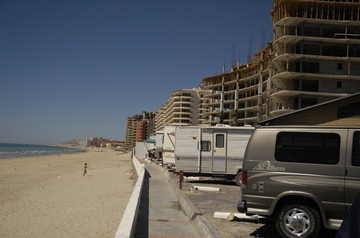
Front row at Playa Bonita RV Park
I’d stay in the park, but I can’t see buying one of the condo properties. As these developments go up, they emphasize the boundary between the “haves” and the “have nots”. The road to the resorts may be gated, paved, and lined with palm trees just like in Florida, but just a block to either side the streets are still made of sand, lined with roofless shacks, trash, mongrel dogs, and other indicators of a poor people. It’s a startling disparity of wealth that is sealing off miles of their beach for the exclusive use of Norteamericanos.
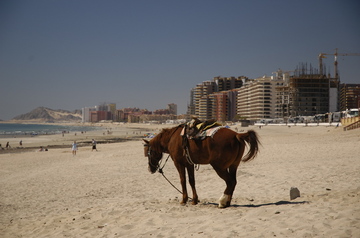
Rent a horse at Sandy Beach
Google Earth location of Sandy Beach.
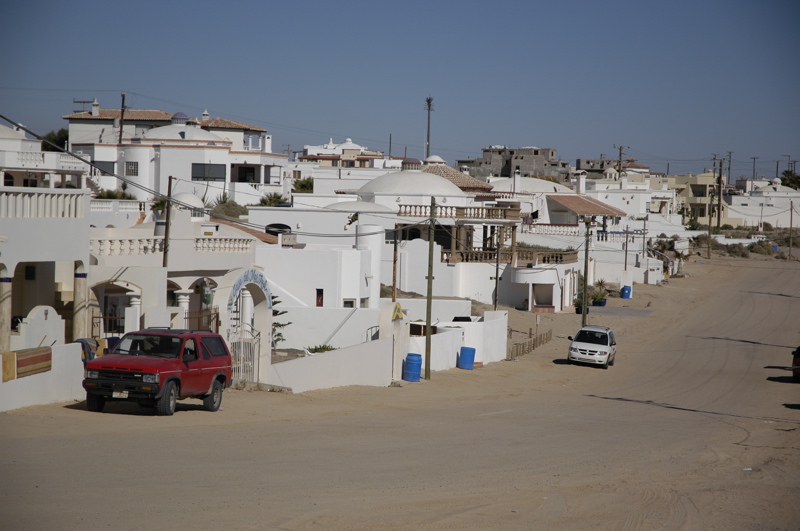
To the south of town, along Los Conchos Beach, development has taken the form of miles of single-family residences clustered along a narrow strip of coastline. Driving through this area is almost surreal because of the strange architectural styles. Most of the houses have a “Mediterranean” influence, but odd visual cues are everywhere. One house brags both Roman columns and Russian minarets. Others are a hodge-podge of Greek, Spanish, and Turkish styles.
The entire neighborhood is accessible only by hard-packed sand streets, and since most of the houses are rentals or “fractionals” (a form of timeshare ownership), the neighborhood is transient and sterile. But for a pure getaway, just to hang with the family and play on the beach, it looks good. The view to the calm blue water of the Sea of Cortez is admittedly beautiful.
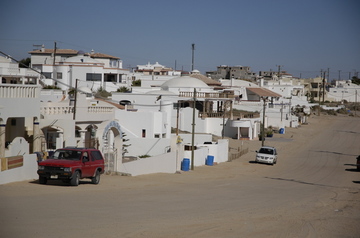
Google Earth location of Los Conchos Beach area.
Do we feel safe? Yes, we do. There’s much more to be concerned about, crime-wise, in New Orleans, Miami, or even tiny Ajo, Arizona. This is not a border town, and the drug problems that go with borders seem to have bypassed Puerto Peñasco. The beach is lightly populated with families playing games on the sand, and college students admiring each other from beach towels. The RV park is full of happy Americans walking around in towels, and not one sign of a criminal element has appeared. We are much more comfortable here than we would be camping in many US downtowns.
The worst problem seems to be badly inebriated college students. Puerto Peñasco apparently wants to reach the Ft. Walton/Destin standard of Spring Break, and the town is getting there. Billboards and signs on the restaurant/BARs advertise to their prurient interests (binge drinking and wet t-shirt contests), and so from late afternoon onward it’s not hard to find evidence of the unfortunate results. Yesterday Ken was favored with a view of a student vomiting next to a trailer here in the park, while the student’s friends offered unhelpful comments ( “Hey, you gonna be OK, man?”). One hopes that it was his own trailer he was tossing cookies on, and not one belonging to some poor visitor from Colorado.
There is a feeling of “anything goes” here, but it’s really not true. They do rent ATVs to college students and let them roar through town on them, helmetless and belching, but the police are still visible where needed. At night the scene is probably horrific with crowds on the streets and various mating displays rivaling Mardi Gras in the French Quarter, but at that time we are back in the Airstream enjoying dinner while the cool sea breeze blows through our open windows.
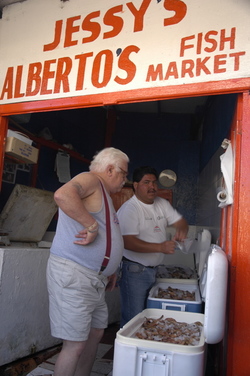
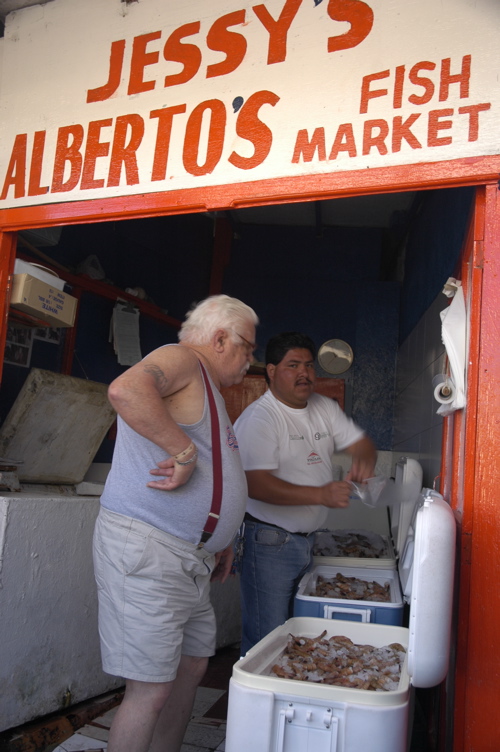
Selling shrimp in the Old Port
The Old Port is the only part of the town that is reminiscent of a border town like Tijuana, Ciudad Juarez, or Nogales. There you’ll find the usual border town shops carrying pharmaceuticals, tacky t-shirts, pottery, and other trinkets. But even still, it is nicer than the border towns. The open-air pescaderia has beautiful shrimp, clams, and fish, and friendly but not aggressive hawkers selling them. We would have bought a bunch of seafood, but this morning I bought a pound of jumbo shrimp for $7 from a vendor who was driving through our RV park, like the fresh-water vendor.
So we’ll grill the shrimp tonight and then go buy something else fresh tomorrow. In fact, since US Customs doesn’t seem to be concerned about Mexican seafood, we may load up on shrimp to bring back to Tucson, on our last day here.
Google Earth location of Old Port and photos above.
March 14, 2007 at 9:15 pm · Filed under Places to go, Travel / lifestyle musings
We were warned about coming to Mexico. “I wouldn’t take my family there!” “You’re crazy to take your car/Airstream into Mexico!” “You can’t take guns there!” “What about the mordida (bribes)?” “Have you had a Hepatitis shot?” And of course, the perennial favorite “¦ “Don’t drink the water!”
The nay-sayers were out in force in the months before we came here. A dozen conversations we had with well-meaning friends can be summarized as simply, “Don’t go. It’s too dangerous.” But none of these people had ever camped in Mexico, indeed, few of them had ever crossed the border.
Many other people said “You’ll love it!” and recommended places to go. All of these people had been to Mexico numerous times. Many of them were in their 60s and 70s and felt safe traveling alone. Quite a few spent months camping in Mexico each winter. We chose to listen to these people because they had the benefit of actual experience.
We did not find a single person who had a first-hand tale of “banditos” or violent crime, and very few had ever gotten sick. It turns out that the banditos are a piece of folklore, about as relevant as tales of Billy The Kid to today’s traveler of Mexican highways.
The two books I consulted on the subject were also reassuring. “Traveler’s Guide to Mexican Camping” said, “People in border campgrounds will warn you not to cross into Mexico because there are banditos, dishonest cops, terrible roads, and language and water problems. The one thing you can be sure of when you get one of these warnings is that the person has not tried Mexican camping for him/herself.”
The “People’s Guide to Mexico” went into even more of a tirade on the subject, too long to quote here. But it was clear from our research, and our recent days in Organ Pipe Cactus National Monument, that we were not about to experience anything nearly as bad as the hazards and crime found on the US side of the border.
Puerto Peñasco is not part of the deep innards of Mexico. It’s a small town on the eastern shore of the Sea of Cortez, only 65 miles from the border. It is also known as Rocky Point by Americans, although that’s not its proper name. Being so close and convenient to the USA, it’s a huge spring break draw this time of year, and so popular with Arizona residents that it is sometimes referred to as “Tucson Beach.”

It hardly feels foreign, with the thousands of US residents filling the RV parks, hotels, restaurants and beaches. Everyone in the tourist-related businesses seems to speak English, dollars are accepted in many places, there are lots of English signs, and services in the RV parks are pretty similar to the US standard. It’s an easy place to visit even for someone who has never set foot outside of the US or Canada before.
Being a tourist town that caters to college students on spring break, most things are geared to serve clueless Americans. We overheard a group of them coming through Organ Pipe Cactus National Monument, telling the ranger they were headed to “that Mexico place.” When she asked which place, they said, “You know, that place in Mexico.” With that sort of knowledge and preparation coming across the border, you can imagine the patience the residents of Puerto Peñasco must have to deal with their customers.
I like to dive into the local scene in a foreign country, and the easiest way to do that is to join the local economy. Hit a grocery store, drop in on the market that doesn’t cater to tourists, or buy lunch from a street vendor or small off-the-beaten path bakery. Today, after Ken & Petey bought us a nice lunch at Playa Bonita Resort on the beach, where the menus and service were in English, I went out to see if I could do a little local business.
My short trip started with a stop at the local Banamex for some pesos from the ATM. Even though the machine only “spoke” Spanish, ATMs are the same the world over, so this was no challenge at all. However, it was interesting to observe the people using the ATM ahead of me: a security guard from a resort, a college student trying to get a cash advance on his US credit card, and an American couple who didn’t realize that in Mexico the “$” sign is used to denote pesos. Thus they were a tad confused that the machine would dispense as much as $5000 at a time. (To approximately convert pesos into dollars, divide by 11.)
I spent 300 pesos at the local Telcel store, buying a Telmex pre-paid SIM card for my spare GSM phone. GSM is the type of cell phone network used most widely in Mexico. Although US cell phones will work in some places, the technology they use is not as widespread. My US-based Verizon phone, for example, reports only an analog signal and not much of that. The Telmex SIM gives my GSM phone a Mexican phone number, so we can make calls in Mexico as inexpensively and easily as the locals do. This will be useful on future trips.
The final stop was to put 100 pesos of gas in the truck. Since Pemex stations sell in liters it can be confusing to determine how much gas you’ve bought, but with a calculator it’s pretty simple to do the conversion. How much gas does 100 pesos get you? Answer: Not much.
The fun part of doing these little errands is that nobody I encountered spoke any English, and so I was forced to communicate with universal tools. These include a smile, a polite and self-deprecating demeanor, as many words of the local language as I can conjure, hand gestures, and endless patience. With these tools I have successfully communicated with speakers of French, Italian, Spanish, German, and Portuguese, and even Czech. I don’t speak any of those languages. It is a very satisfactory feeling to manage to conduct even a minor transaction (such as buying gasoline) with only a smile and a few words, and I think the person on the other end of the transaction usually feels the same way.
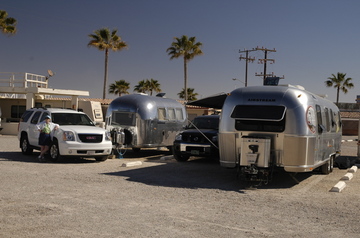
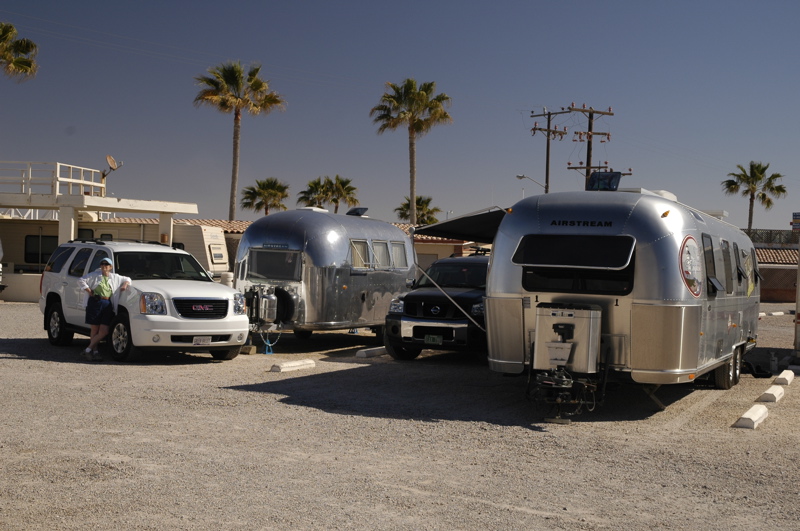
Our campsite next to Ken & Petey at Playa de Oro
Google Earth location of Playa de Oro campground.
There are several RV parks right along the beach, and we’re in one of them: Playa de Oro. This place is located south of the Old Port, near a lot of tourist “restaurant-bar” spots (emphasis on BAR, especially this month). The park is 320 tightly spaced full-hookup sites on a crushed shell surface and no view except on the beachfront sites. At night the restaurant-BARs turn on their music and we get a free, somewhat muffled, concert of dance music until about 2:30 a.m. Last night it was noisy but not unbearable, and we managed to sleep through it.
We don’t know if the water in this campground is safe to drink, but we arrived with a full tank (39 gallons) of fresh water and it should last for the four days we will be here, with conservation. If not, a vendor drives by daily in a pickup truck loaded with 5-gallon jugs of agua purificada, and when he honks his horn all we need to do is wave to him and buy a jug, just like we would for an ice cream truck. As a result, we have not connected to the water spigot at our site.
Similarly, we have avoided using the AC power. I tested the power outlet for correct wiring (ground, polarity, hot/neutral) using the simple tester that Airstream provides with every new trailer, and it passed. That’s more than I can say for some US parks, most recently one in New Mexico we stayed at. However, my voltage tester is dead, so I can’t verify whether the current is in the safe range for running certain appliances, like the air conditioner. Mexican campgrounds have a reputation for wildly fluctuating voltage, sometimes dropping during the day and rising at night, or spiking without warning.
As in other desert locations, there’s endless sunshine, so our strategy is to simply not plug in except for a few minutes in the morning to run the coffee pot. With the cool sea breezes we don’t need air conditioning anyway, and the solar panels are supplying more than enough power each day to fully replace what we use at night. My laptop, which comes out only once every other day to record my musings, is running off DC power and is thus insulated against variances in the AC voltage.
For the various comforts and liabilities listed above, we are paying $19 per night, which is very reasonable by US standards for a spot about 200 yards from the beach. In Fort Myers Beach, for comparison, a similar site cost $52 per night, although the beach was prettier. The beach is not bad here but certainly not up to the gorgeous sugar-white standard of the Florida barrier islands, and not quite as nice as the beaches north of town, which are wide, shallow, and uncrowded even during Spring Break.
The water is reasonably clear, if somewhat cold, and the beach is a coarse tan sand which at low tide reveals shelves of the underlying volcanic basalt. Anyone on the beach will soon encounter all types of beach vendors, selling “Cuban” cigars, jewelry, trinkets, and other assorted junk. Not one so far has offered us the stuff one might expect on the beach: cold drinks, sunscreen, parasols, folding chairs, inflatable beach toys, or kites.
March 13, 2007 at 8:56 pm · Filed under Uncategorized
Organ Pipe Cactus National Monument has changed lately and not for the better, I’m sorry to say. Continuing border problems and the threat of violence from drug-runners has caused the park service to shut down all back-country hiking trails and all the border roads in the park. This effectively eliminates the majority of access to the park’s many subtle delights. Old mines, historic ranch sites, even the tiny habitat of the endangered Quitobaquito desert pupfish ““ all are off limits now. Now it seems that visitors to the park have joined the desert pupfish as an “endangered” species needing protection.
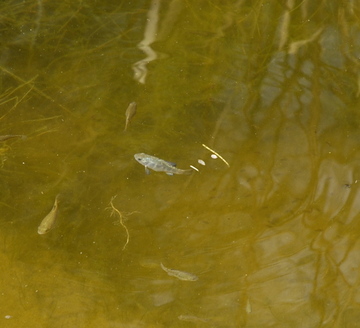
The endangered Desert Pupfish. Note the male fish is blue.
A year ago the border was a problem too, but only a small portion of the park was closed at that time. The most recent closures have changed the essence of the experience at Organ Pipe. It is still a peaceful and beautiful place, but the tension of border problems is an ever-present cloud. The rangers have to spend too much of their time explaining why you shouldn’t explore parts of the park ““ something that must really frustrate them. The Visitor Center is named for a ranger who was shot to death by criminals who crossed the border.
A short distance from the campground you can find large blue flags on a tall pole, indicating one of several humanitarian water stations. These are put in the park to aid the everyday “UDAs” (Undocumented Aliens) who attempt to hike 80 or more miles through brutal desert conditions with completely inadequate preparation. Many of them have no idea what conditions they will face, when they cross the fence. Once they’ve realized their mistake, rather than dying in the desert they can get water and wait for help (which will include deportation).
Fear is now a factor in the park. The park visitors, the rangers, the border control agents, and the UDAs all feel it. Hiking in the park in years past we would have looked for rattlesnakes, gila monsters, cactus wrens, or kangaroo rats. Now, will you see any of those or will you be too busy looking for an armed drug runner, a desperate family without enough water, or a giant pile of trash left by border crossers long since departed?
I don’t mean to pick on Organ Pipe Cactus National Monument. It’s still a wonderful park and it doesn’t deserve the problems it faces. We’ll come again and enjoy it again. But the huge changes we’ve seen here in just one year reminds me that all parks are subject to change as a result of environmental, political, climatological, or even geographical changes.
When you visit one, try to experience as fully as your time allows. Next time you visit, things may have changed, especially in border parks. During our first visit to Big Bend National Park, we were able to freely cross the Rio Grande to have dinner in Boquillas Mexico. Now that’s illegal. In Hawaii Volcanoes National Park, lava flows can ebb to barely anything, so if the lava is visible, it’s worth staying until dusk to see it!
One year I planned to visit Cabrillo National Monument during a business trip to San Diego, but my free day was September 12, 2001, and the monument ““ being close to a naval base ““ was off-limits for a few panicky days. It was four years before I got another chance at it.
In Sabino Canyon (part of the Catalina National Forest in Tucson), floods during the last monsoon season wiped out trails that we could have hiked the previous year, if we’d taken the time. We’ve accumulated dozens of other examples, too. The point is that even in national parks, where the goal is preservation for future generations, nothing is static. Seize the day!
The good news is that Organ Pipe is not heavily visited, so seekers of peace and quiet can still find it here. The RV campground in Organ Pipe Cactus National Monument has no hookups. The park also takes no reservations, cell phone coverage is marginal, and the park is far from population centers and services. These factors keep visitation to the campground down.
Last year we had to leave the park earlier than we wanted because the furnace chewed up our power at night and even running the generator for the maximum four hours allotted each day wasn’t enough to keep up. This year we have solar panels, like most of the other residents here. Solar is ideal for places like Organ Pipe because it silently recharges the batteries all day, not just during the posted generator hours, and there’s plenty of sunshine here. We have had more than enough power to fully recharge the batteries every day.
Next to us are Richard and Norma, who coincidentally I met last year at the International Rally in Salem OR. Richard is a woodcarver, and his trailer has several delicate hummingbird carvings hanging from it. He carved one just for Emma, too, from a single piece of wood. It’s a beautiful thing, and just the right size and weight to be a good full-timer’s souvenir. We’ll find a place in the Airstream to hang it.
Two spaces down are Bert & Janie, and today Ken & Petey showed up in their 1964 Airstream Globe Trotter, so that makes four Airstreams in our immediate area.
Our Google Earth campsite location in Organ Pipe.
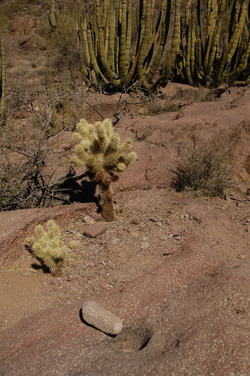
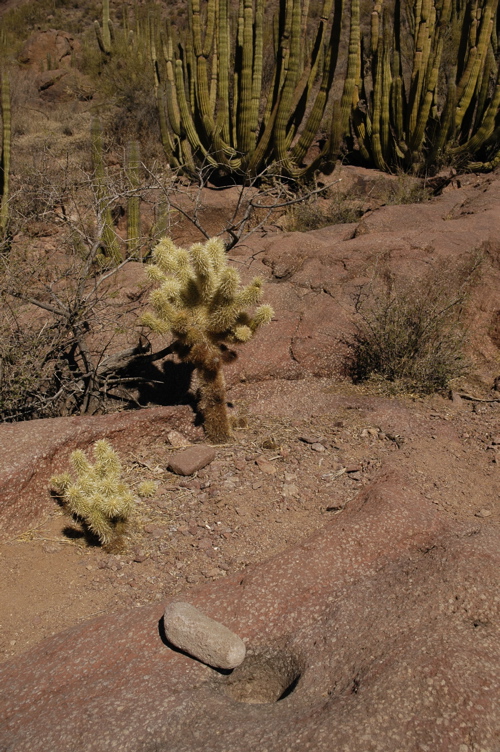
A grinding hole, cholla cactus, and organ pipe cactus
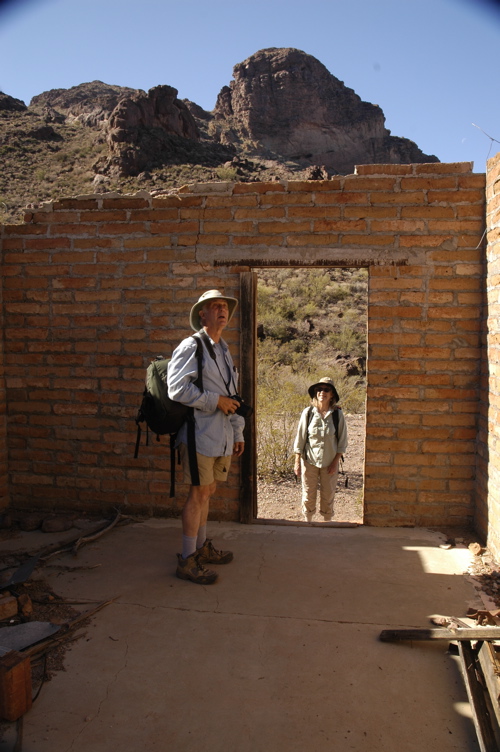
Today Bert recruited me for a hike by Alamo Canyon. Janie came along, but Eleanor stayed back because Emma was still sleeping. The hike started about 10 miles north of the campground (and three miles down a bumpy dirt road), following a perennial stream to an old one-room ranchhouse and corral. Along the dry streambed there are ancient Native American grinding holes in the bedrock, fifteen by our count. These are quite possibly thousands of years old, and were used to grind up mesquite seeds and other gatherings. We’ve encountered these in Big Bend National Park and other places, but they always are awe-inspiring and make me think about how the people before us managed to live here.
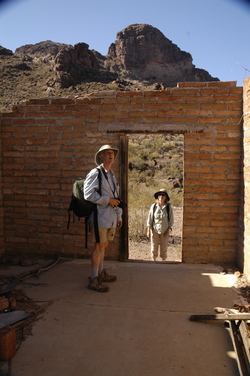
Bert & Janie explore an abandoned one-room ranch house, Alamo Canyon
This evening Bert went back out to Alamo Canyon to shoot a particular night scene. He wanted to capture saguaro cactus against the Ajo Mountains with the stars creating circular trails overhead. This picture requires a tripod, very clear skies, a view of the Polaris (the north star), a cable release, and a camera that has a “Bulb” setting that holds the shutter open indefinitely. He came back successful, with a gorgeous 15-minute exposure that appears on his blog. I wish I’d tried it too, but we hung back to attend the 7 p.m. ranger talk about Organ Pipe’s sister park in Mexico, called Pincate.
Tomorrow we will disperse. Ken & Petey will follow us across the border to Puerto Peñasco, and Bert & Janie will begin the long trek back to their home in Montana. They’ve been on the road for nine months, ever since we saw them at their home last July. It’s time for a break for them. I hope they’ll be on the road again this fall so we can have more hiking and bicycling trips together.
March 12, 2007 at 8:21 pm · Filed under Roadtrips
Although the blog is “officially” paused for a few days, I find that after 17 months of daily entries I am compelled to write down some of my observations, lest I forget them. Things are happening so quickly and with such vibrant color that I can hardly keep track of them all; Both visual stimuli and personal encounters are engaging and exciting now that I am free of work concerns for a week, and I am finding that I notice more details. Even the tamales Eleanor made last night seemed to be full of subtle flavors, and so I ate more slowly and anticipated the next course: a slice of Dutch Apple pie left over from our visit with Mike & Sam last week. This is the delicious difference of vacation.
Along the road east from California there seemed to be more to explore than when we went westward, too. Coming down from Octotillo Wells we passed at least a dozen wonderful-looking spots for boondocking. You could spend a year in Anza-Borrego Desert State Park and never spend a night in the same place. I wish we had time to try them all.
Then the shimmering blue stripe of the Salton Sea appeared. At first I thought it was a mirage, because I’d heard the Sea was slowly evaporating (which it is), but the Sea remains quite large. A lot of new development is underway on the west side, replacing what had been a very quite section of uninhabited desert. I don’t know who wants to live there beside a vanishing and overly-salty artificial lake with environmental problems, but apparently there is demand.
Along I-8 the highway passes through strange contrasts: stark desert bordered by canals filled with fresh water, then lush green landscapes, then desert again. In places the green is so widespread and rich with carrots, avocados, broccoli, and grass that it appears to be the norm, but then I would remind myself that every inch of that green is courtesy of irrigation. Without the canal system bringing water there would be little other than cactus.
There are many more things we’ll want to explore off I-8 later. There is a massive area of tall sand dunes where the four-wheelers play, parking their “toy hauler” RVs in flat spots near the highway. There are so many that they seem to form their own communities on the weekends. There is an interesting petroglyph site, and the RV mecca of Quartzite. There are Native American historical sites, and small towns.
In Yuma we stopped at a grocery store, and got a knock on the door from a couple that told us, “We’re one of the very few people full-timing in a Safari 30 bunkhouse!” I said, “Well, now you’ve met the other people full-timing in the Safari 30.” Turned out they had read the blog, knew about details of our trailer like our disc brake upgrade, and had subscribed to the magazine. This sort of chance meeting is happening more to us lately. I think we’re becoming notorious.
Let me try to convey where we are now. You drive along I-8 to a tiny truckstop town called Gila Bend. Pick up fuel there, because it’s going to be a long way before you see it again. From Gila Bend, take the lonely two-lane strip called AZ 85 straight south to Ajo, 60 miles away. In Ajo you can find some groceries, food, and gas, but only if the grocery is open (it wasn’t on Monday). Ajo is a tiny land-locked copper mining factory town, but the copper mine is closed and now most of the residents work for the Border Patrol.
Continue south through the intersection ““ hard to call it a “town” ““ called Why (and the “Why Not Café”), and about 25 miles later you’ll reach the formal entrance of Organ Pipe Cactus National Monument.

The Ajo Range
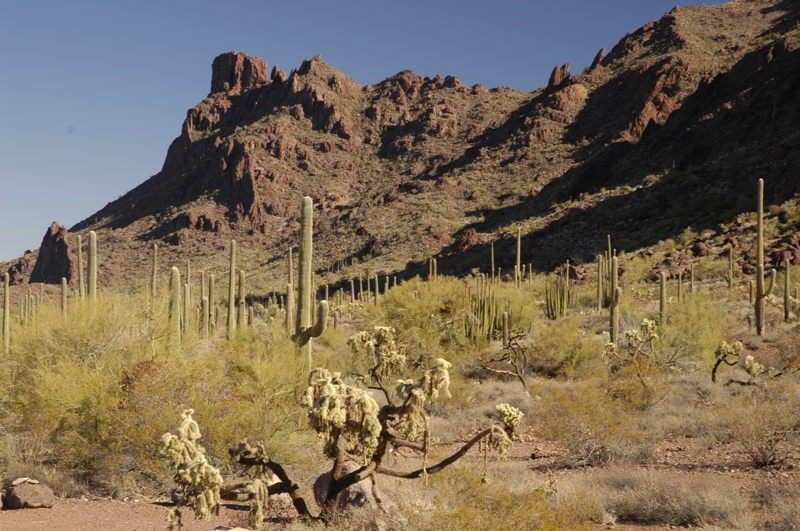
Two things happen as you enter Organ Pipe Cactus National Monument. First, the cactus starts to change to a mixture of saguaro and organ pipe, with other common Sonoran desert plants: ocotillo, creosote, prickly pear, palo verde, and cholla. Along the eastern side of the road the view is suddenly dominated by the jagged purple volcanic ridges of the Ajo Mountains, which look stunning in the late afternoon sun.
Second, you may encounter a Border Patrol checkpoint. They aren’t interested in people heading south, but it is commonplace to stop for a check when heading north. Usually this entails nothing more than a quick question from the agent before they wave you onward.
We arrived at Organ Pipe near sunset, so there was just time to dump the tanks, fill up with fresh water, and run over to Bert & Janie’s trailer, just a few spaces away. Emma insisted on a “super quick, quickest bike ride ever!” so we quickly unfolded the Birdy Bikes and pedaled around the campground to the setting sun.
It is warm here, as I had hoped. Last time we were here (January 2006) the nights were around 40 degrees with a strong cold wind. Now, in March, it is running 80-90 during the day and dropping only into the mid-60s at night. Bert & Janie have been sleeping with all windows and entry door open, with a fan running. Janie warned me not to come by their trailer late at night because she had the bear spray ready for an intruder.
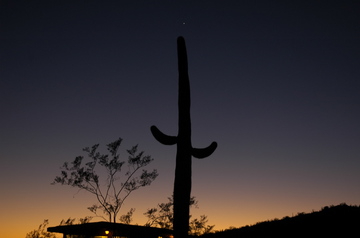
Saguaro cactus pointing at Venus
It is rare that we get to sleep with the windows open, because it is usually too cold, too humid, too smoky from nearby campfires, or there is too much pollen. But in the dry desert it is remarkably comfortable, so it was with some glee that I opened all the windows for a night of really fresh air. Organ Pipe Cactus National Monument offers no hookups, so there is no option for air conditioning at night, which is actually good since with AC we would have had the trailer sealed all night and not enjoyed the fine night air. We’ll do the same again tonight.
« Previous entries ·
Next entries »