September 19, 2006 at 4:56 pm · Filed under Uncategorized
Since last February, when we got serious about continuing our trip for another year, Eleanor has been saying that need to make the trailer as much of a “home” as possible. We’ve done a lot of decorating and upgrading since then, and now that we are settled in Vermont for a while, she’s taking to the opportunity to change the curtains.
We’ve never been wild about the curtains that came with the trailer. We like colors, and the factory curtains were basically bland. Today she got working on the curtains in Emma’s bedroom. These will be simply a fabric stitched to the existing curtain. This is the easiest approach.
In our bedroom, I’ve requested a light-blocking fabric backing, and more fullness to the curtains so that they don’t need Velcro closures to stay shut. Eleanor is going to make all-new curtains there.
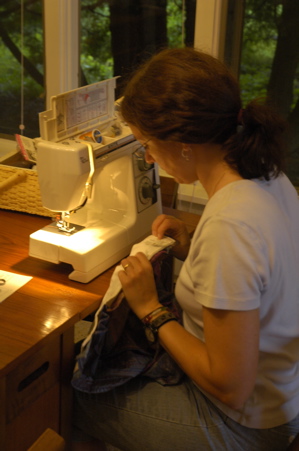
We haven’t picked out a fabric for the middle curtains (dinette and living space). They may carry the theme of one of the bedrooms, or be something entirely different. I know a designer would say we should carry one theme throughout since it is such a small space, but we’ve haven’t made that decision yet.
More plans are in the making. Bert and Janie report that they need more time in Nova Scotia and are wondering if we can push our plans to leave New England back a week. I’ve also got business that may keep us here another week, which is a shame, since we’ve been invited to visit Virginia Highland Haven Airstream Park and it closes by Oct 15. Looks like we won’t make it.
Last year I would have pushed hard to get out early and make every date we’ve been invited to. But going forward we need to slow down. We logged 30,000 miles in less than a year, crossing the country four times. We made about a hundred different stops. This year, we’re going to stay longer, drive less, and probably miss a few things in the name of more relaxed travel.
September 18, 2006 at 11:21 pm · Filed under Uncategorized
Comments from a few friends of mine recently have made me realize that people often get the wrong impression of what we are doing. Seeing us downsizing to a trailer, giving away personal possessions, and extolling the virtues of a mobile life, people think we are dropping out of society.
I think the logic goes like this: If you don’t have a house, and you don’t have a lot of stuff, and you roam the country, and you homeschool, you must be rejecting society and working to become some sort of combination hippie / Unabomber. All we need now is to take the wheels off the Airstream and find a spot in Montana to park it forever, eh?
Actually, what we are doing is “right-sizing” our life. The big house and many possessions aren’t happiness, for us. Neither is living in a trailer park somewhere. The right balance is somewhere in between. Exploring the country in a fully mobile fashion with only 200 square feet of space takes us to the opposite extreme of where we were a few years ago, and thus we can weigh the benefits of each mode of life and decide what we ultimately want to settle on.
So we really do have a master plan. It evolves as we learn more about what we need and don’t need. Our travel adventure has become an essential part of the process of figuring it out. Full-time travel is wonderful and it works for many people for years, but in our case we expect to end the full-time segment in the next year or so.
We’re already scouting for places to call home for at least six months of the year, and give all of us the benefits of a local community while keeping our option to travel open. That’s a tall order, which is why we will spend another year working it out.
Today’s developments: Eleanor got her semi-annual allergy checkup and it was generally good news. [One tidbit: Zyrtec is available over the counter in generic form in Canada. Guess where we’ll be going soon?] Afterward, she slaved another day at the storage unit, offloading a carfull of stuff on a friend and generating another box of trash. Meanwhile, I ended up donating six boxes of books to a local library, since the used-book buyers in the area weren’t buying. I did manage to get $25 for a box of paperback mysteries and sci-fi books, but the good stuff — over 50 hardcovers — will support the library in its book sale this October.
September 17, 2006 at 9:37 pm · Filed under Uncategorized
As planned, Eleanor and I went to our storage units again today for another session of sorting and groaning. We spent all day Friday there, when I should have been working, digging through boxes and finding buried “treasures” that we have not missed in the past year at all.
There is a particular category of box we call the “UGH” boxes, because of the sound we inevitably make when we open them and find a collection of what the movers euphemistically called “miscellaneous”. The best “ugh” boxes contain a wide range of stuff we absolutely do not need, yet which is just a bit too good to throw away directly. Thus, we have to sort through it, pull out the trash, find homes for numerous other items, and re-categorize the few things we are actually planning to keep.
Friday we sorted through at least a dozen “ugh” boxes, and ended up with 440 lbs of trash. I know the exact weight because the Waste Transfer Center weighs us going in and out. There’s a $39 minimum charge each time we go through, up to 760 lbs, so we are trying to keep our visits to the dump to a bare few. We also brought about eight boxes of stuff to friends and relatives over the weekend.
Today we met friends, a younger couple with a large house, and they took a pickup truckload full of stuff — and they’ll be back on Monday for more! Even still, our storage units are still more than half full. Upon examination, it appears the major culprits are: (1) furniture; (2) food; (3) books. Eleanor stored a lot of her pantry because we thought we’d be back in six months. There were about 20 boxes of non-perishable foodstuffs stored, which we have been sorting and sharing with anyone who will take some. Of course, some of it has ended up in the Airstream, too.
As you might guess, I read a lot. My library is not particularly large for someone in the writing profession, but nonetheless I have more than a dozen boxes of books stored. I decided to sell or give away all the books except a few exceptional or rare ones. Today I culled out eight boxes of books and they are loaded in the back of the Armada for dispersion on Monday. Some will get mailed to friends, most will end up at the local used-book store.
I kept some of my favorite authors: Paul Theroux, Stanislaw Lem, Primo Levi, Ian Fleming, Philip K Dick, and a few others. I also kept a few favorite references, including my collection of caving books and mushroom books. It took me years to get those together. All the Peterson’s field guides (birds, mushrooms, wildflowers) will go in the trailer for future hikes. The Heinlein collection will go to Brett, who appreciates science fiction. All the popular authors who somehow managed to slip into my library but who I never liked, will go to the used-book store: Dick Francis, Stephen King, Clive Cussler, etc. We kept a few Agatha Christies for book swaps — they are almost as good as cash in a campground.
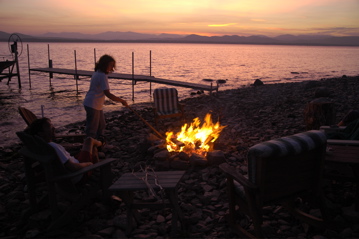
After logging six hours at the storage units, we came back to Charlotte for a fire, roasted hot dogs, s’mores, and a big paper-burning session. Goodbye, decade-old tax forms, pre-2000 credit card statements, maintenance records of cars and closing documents from properties we no longer own, divorce forms from 1989, and much more.
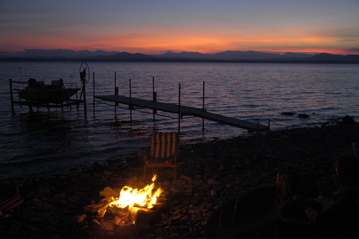
It is a huge job, culling down the detritus of decades, but I think of it as a spring cleaning long overdue. Except perhaps for a rocking chair, nothing we relinquished today will be missed.
September 16, 2006 at 7:25 pm · Filed under Uncategorized
I mentioned a few days ago that Eleanor and I used to go caving often. In our travels over the past year, we’ve visited numerous public and commercial caves, including Lehman Cave in Great Basin National Park, Kartchner Caverns, Mammoth Cave, Lava River Cave, and Oregon Caves National Monument.
Today, I joined my brother and a friend on a day-long caving expedition to the first “wild cave” I’ve visited in at least three years: Eagle Cave, atop Chimney Mountain in the Adirondacks of New York. Eagle Cave is made of talus (fallen stone), like the small one we visited in Pinnacles National Monument last December.
The cave is tricky to navigate, like most talus caves. The collapse of rocks often creates maze-like passages which look very similar. We had maps from previous cavers, which helped a lot. To traverse the cave, you first need to drive way out in the Adirondacks (2.5 hours for us), and then climb Chimney Mountain, which is about a 1-mile hike, half of which is steep.
Parking location for Chimney Mountain. (You need Google Earth to view this.)
Then in the cave, you need a map, water, snacks, three sources of light, kneepads, warm clothes, and a helmet. Gloves are a big plus. There’s a lot of scrambling over wet and cold rocks involved. To get into the lower levels of the cave, you also need the ability to descend and climb a 12-foot dropoff. This sorts out the unprepared, since there’s only one way down and one back up!
The cave has at least five levels, all of which we explored. The second level has a Bat Room where we saw many Little Brown Bats sleeping. The third level is very confusing without a map, and the fifth level is just plain maze-like. As late as August you can find ice in the lower levels. We were in there exploring for over three hours! It was great fun, even with the 12-foot free rope climb at the end.
If you want to try this sort of caving, go with someone who knows what they are doing. The best-prepared people tend to be members of the National Speleological Society. People who adhere to the principles of that organization will know the risks of caving, know the equipment to bring, appreciate the need to protect the cave (taking out trash and not disturbing the bats), and hopefully have the sense to avoid getting into dangerous situations.
Tomorrow we need to do penance at our storage unit again, and then hopefully we can reward ourselves with some time on the boat.
September 15, 2006 at 7:36 pm · Filed under Uncategorized
If you subscribe to Airstream Life magazine, you may have noticed that we strive to make every magazine cover “different” and beautiful. It’s one of the hardest jobs in the magazine.
Each quarter, our Art Director, Jim Burns, reviews numerous images to select one worthy of the cover. It’s harder than it looks. A cover photo has to be technically perfect, high-resolution, colorful, and indicative of the Airstream lifestyle or interest area. For the upcoming Fall issue, we have an article on “gypsy caravans, the first RVs” and so Jim wanted to use an image of one of these colorful wagons.
Here’s cover test #1

This reduced JPG is blurry, but you can see it’s a nice colorful image. We almost went with it, but when Jim got the proof back from the printer he felt it didn’t have the quality we needed. The image was scanned from a print we got out of England, and often scans don’t hold up when reprinted.
Here’s cover test #2

This is also a nice image, but the composition is flawed. On the right side, which you can’t see because it is clipped off on this image, there’s half a man. He’s a distraction from an otherwise great photo. So this one was dropped from consideration as well. But both of these images are good enough to be used inside the magazine, and you may see them there.
So what image did make the cut? Our friend David Michael Kennedy contributed a really great photo of himself taken by his girlfriend Heather Howard. They live in a 1960 Airstream full-time and roam the country taking pictures professionally. I can’t reveal it here, but you’ll see it soon enough when the Fall/Winter issue comes out in mid-October!
September 14, 2006 at 10:13 am · Filed under Maintenance
We’re back to “Cat in the Hat” weather here. I am reading blogs from friends in California, Colorado, and Florida, and all of them are enjoying wonderful warm — even hot — weather. Yesterday it never broke 61 here and rained most of the day. My instincts tell me to flee for the south, because the freedom to seek out better weather is a privilege of Airstreaming. But Eleanor says otherwise. We still have a lot to do here.
Eleanor is starting a curtain project. We’ve never been fond of the curtains that came with our trailer, so she has found something funky to replace them. She’s going to back the fabric with light-blocking material so we can get real darkness in the bedroom when we want to.
She’s also come up with a better solution to our bath mat problem. We bought a small standard rubber-backed bath mat some months ago. But when it got dirty, we found it was very difficult to get cleaned on the road. When we stop for laundry we don’t want to toss it in with the clothes, and yet running a separate wash for it wastes time and resources. Worse, it can’t be dried in the dryer due to the rubber backing, so it ends up wet for days before we can use it again.
Instead, she bought two small towels that match our bathroom decor, and she’s simply sewing them together back to back. This makes them thick enough to serve as a mat and it’s easily washable. I’ll show you a picture when it’s done.
Emma is working on a project today too: making a suncatcher out of glass beads.

One of my projects is to search for things in the trailer we can dump in storage or give away, to lighten our load and free up storage space. The latest thing is my Windows laptop, an elderly Pentium III running Win 98. I kept it only because there was one program I needed to run once every three months for the magazine. I’ve since found a better version that runs on Mac, so the Windows laptop is history, saving us about 6 lbs.
That may seem like a ridiculous economy in an 8000 lb trailer, but every ounce counts. It’s the little things that add up surreptitiously. I like to keep the trailer light. We can carry up to about 2000 lbs (including optionally installed equipment like solar panels and extra batteries, plus fresh water and propane). In reality, by weighing our rig at truck scales every few months, we’ve found that our typical load is only about 1600 lbs, and that’s as a full-timing family of three, running a business!
That’s largely due to scrupulous attention to what we carry. I see people with chainsaws, cinder blocks, hatchets, hundreds of feet of hose, cast iron cookware, solid wood flooring (added in after-market), heavy custom furniture, giant air compressors, full mechanic’s chests of tools, and racks of canned goods. No wonder so many people are driving around with overweight rigs.
Even if you don’t haul a lot of obviously heavy stuff, culling down the excess quantities of lightweight stuff is still important. We don’t carry five pairs of shoes when we only need three. Tools are kept to a basic kit suitable for most situations, not every possible situation. Paper is culled out often — recycling magazines and scanning almost everything else. Even Emma’s rock collection is limited to samples < 1″ in size, and the collection is reduced by half every time she flies back to Vermont. My goal is to take at least 100 lbs out of the trailer while we are here. I think we are probably halfway there.
Solar report: with gloom and rain all day, we captured only about 10 amps all day. Our battery bank is down to about about 57% (reported). In fact, we have more power than that. We initially set the TriMetric monitor to report only about 60% of our actual capacity, so it reads conservatively. That way, we don’t overdraw the batteries. If it hits 50% reported, I’ll probably plug the trailer in for a full charge. If so, it would be the first time we’ve gotten that low since we installed the solar panels and four batteries in May.
September 13, 2006 at 2:15 pm · Filed under Uncategorized
Yesterday was one of those fabulous late-summer days in Vermont. We took the boat out for what will probably be the last trip of the year, and my brother Steve went waterskiing.

Steve’s a pretty handy waterskiier, and the lake was almost glassy calm at sunset, so I had the opportunity to shoot some nice photos. I’ll post a few on Flickr. All were taken with the new 55-200 mm zoom lens, using ISO 400 for better stop-action on the water.
These days I’m usually alternating between Program mode on the camera and Aperture priority. Instead of Shutter priority I stuck with Program mode and occasionally spun the command wheel on the Nikon to get a higher shutter speed. (If you don’t have a Nikon digital SLR none of this probably makes sense.)

The sunset light made for some fine lighting on the splashing water. I wish we could go out again today but some weather has arrived … rain and gloom. Summer is over up here in the northeast.
It has been cool enough at night (40s) so that we are using the furnace now. We still haven’t plugged the trailer in, and with the gray skies today it will be a test of our battery bank and solar panels to stay charged. So far we have been unplugged for three and a half weeks, a record — but of course one week of that we were not in the trailer. I’ll be interested to see how much solar we can capture today and tomorrow. We may plug in tomorrow if the batteries go as low as 50% of capacity.
« Previous entries ·
Next entries »